The lingerie market has become more competitive, especially across Europe and North America. New brands need faster product launches, online sellers need frequent updates, and traditional wholesalers are under pressure to offer more styles without taking on heavy product development costs.
For many buyers, working with an OEM or ODM lingerie manufacturer is a practical way to reduce investment and improve sourcing efficiency. However, one common question remains: should you choose white label lingerie or private label lingerie?

Choosing the wrong model can lead to high MOQ pressure, slow delivery, excess inventory, weak brand differentiation, or products that do not match your target customer. This guide explains the key differences between white label and private label lingerie, including customization level, MOQ, lead time, cost, exclusivity, and suitable business scenarios.
What Is White Label Lingerie?
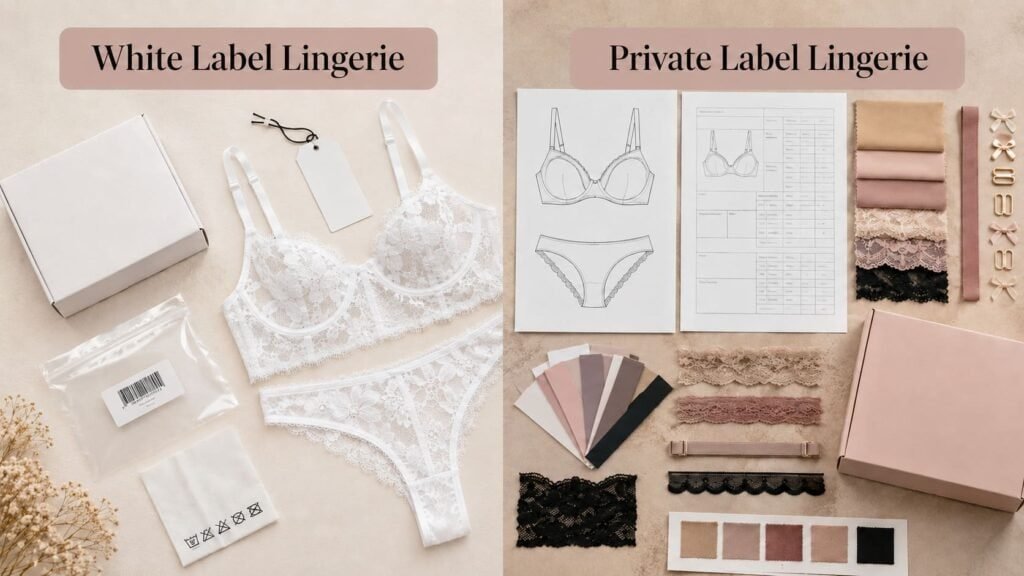
White label lingerie refers to ready-developed or standard lingerie products supplied by a manufacturer and sold under a buyer’s own brand name. The supplier has usually already decided the product design, fabric, fit, color, construction, and size range. The buyer mainly adds branding elements such as logo, hangtag, care label, packaging, barcode label, or outer box design.
In simple terms, white label lingerie allows a buyer to sell an existing product with their own brand identity. The product itself is not developed exclusively for one brand. The same or similar style may also be offered to other buyers, depending on the supplier’s business model.
White label lingerie often covers mainstream commercial categories such as bras, panties, shapewear, lingerie sets, swimwear, sleepwear, and adhesive bras. It is commonly used for fast market testing, small-batch replenishment, seasonal product launches, and buyers who do not yet have a full product development team.
The biggest advantage of white label lingerie is speed. Buyers do not need to start from fabric sourcing, pattern development, fitting, mold opening, or multiple sampling rounds. For small businesses, this can reduce early-stage risk and help them enter the market faster.
However, white label also has clear limitations. Since the product is not exclusive, it is harder to build a strong brand identity or premium pricing. Buyers also have limited control over fabric, cup shape, fit, color range, size grading, and construction. If many sellers are offering similar products, competition often becomes price-driven.

What Are the Advantages of White Label Lingerie?
White label lingerie is usually suitable for businesses that want to enter the market with lower investment and shorter lead time. It does not require the buyer to have a professional design team, pattern maker, or product technician at the beginning.
The MOQ is often lower than fully customized lingerie because the product has already been developed or produced in standard forms. This makes white label more accessible for startups, small online sellers, and wholesalers who want to test product categories before committing to larger production.
Another benefit is shorter delivery time. If the product is available in stock or already part of the supplier’s standard range, shipment can be much faster than private label production. This is useful for marketplace sellers, independent online stores, and wholesalers who need quick replenishment or seasonal product updates.
White label also helps reduce early financial pressure. Buyers can start with a smaller product range, collect customer feedback, and decide later whether to move into deeper customization.
For new lingerie businesses, white label can be a practical first step. It allows the buyer to test sales channels, customer preferences, price points, and product categories before investing in exclusive private label development.
What Are the Limitations of White Label Lingerie?
The main disadvantage of white label lingerie is product similarity. Since the same or similar products may be available to multiple buyers, it is difficult to create a truly unique product line. This can weaken brand differentiation, especially in competitive categories such as basic bras, seamless underwear, shapewear, lingerie sets, and swimwear.
White label buyers also have limited control over the product itself. They may be able to change the packaging or labels, but they usually cannot change the fabric, cup shape, support structure, lace pattern, elastic tension, sizing, color range, or technical construction.
Profit margin can also be limited. When many sellers offer similar products, customers can compare prices easily. This makes it harder to build a premium brand story or long-term product advantage.
White label also may not be suitable for brands with a clear target customer or specific fit requirement. For example, if a brand focuses on plus-size bras, seamless bonded bras, nursing bras, functional shapewear, or premium swimwear, standard white label styles may not provide enough technical control.
For brands that want to build recognizable product identity, white label can be useful at the beginning, but it is not always strong enough for long-term brand building.
What Is Private Label Lingerie?
Private label lingerie is a more customized production model. In this model, the buyer works with the manufacturer to develop products based on their own brand direction, target customer, fit requirements, material selection, color palette, packaging, and commercial positioning.

Private label does not always mean every detail must be invented from zero. In real B2B production, it can start from a sketch, reference sample, photo, measurement chart, existing base style, or tech pack. The key point is that the final product is developed specifically for the buyer’s brand and is not simply a ready-made item sold to many customers.
Private label lingerie can cover a wide range of categories, including bras, panties, plus-size lingerie, bonded bras, seamless underwear, shapewear, nursing bras, period panties, swimwear, teen underwear, and adhesive bras. It is especially valuable when the product needs specific fit, fabric performance, cup shape, support level, size grading, or market compliance requirements.
This model usually includes sample development, fitting, revision, material confirmation, pre-production sample approval, bulk production, quality inspection, and shipment. Because of this, private label requires more time, higher MOQ, and more buyer involvement than white label.
For brands that want long-term differentiation, private label is usually the stronger model.
What Are the Advantages of Private Label Lingerie?
The biggest advantage of private label lingerie is product differentiation. The buyer can develop a product that better matches the brand’s target customer, price level, retail channel, and market positioning. This helps avoid direct competition with identical products.
Private label also gives brands more control over materials, fit, function, and appearance. In lingerie, small details matter. Cup shape, strap position, wing structure, elastic tension, lace placement, fabric recovery, and seam finishing can all affect comfort, support, return rate, and customer reviews.
For functional categories such as shapewear, plus-size bras, nursing bras, bonded bras, seamless underwear, period panties, and swimwear, customization is often necessary. These products usually require more precise construction, fabric testing, and fit control than basic ready-made styles.
Private label can also support higher profit margins. When the product is unique and better aligned with the brand’s audience, it becomes easier to build a premium offer, improve customer loyalty, and reduce direct price comparison.
For mature brands, private label is not only a sourcing model. It is part of the brand’s product strategy.
What Are the Limitations of Private Label Lingerie?
Private label lingerie requires a higher level of commitment. Buyers need to be clear about their product direction, target customer, size range, price point, and sales plan. Without this clarity, sample development can become slow, costly, and inefficient.
MOQ is usually higher than white label because the factory needs to purchase fabrics, trims, elastic, labels, packaging, and sometimes molds or special components specifically for the project. For seamless underwear, bonded bras, molded cups, custom lace, printed swimwear, and silicone adhesive products, MOQ can increase further because upstream material suppliers also have minimum order requirements.
Lead time is also longer. A private label project may involve fabric sourcing, sample development, fitting, revision, testing, pre-production approval, bulk production, and inspection. Compared with white label, the total development cycle can be significantly longer.
There may also be additional upfront costs, such as sample fees, mold fees, artwork fees, printing setup costs, lab testing, or special packaging development. These costs are not necessarily high compared with long-term bulk orders, but they must be planned before the project starts.
Private label is powerful, but it is not suitable for buyers who want very low MOQ, immediate shipment, or no involvement in product development.
White Label vs Private Label Lingerie: Side-by-Side Comparison
For B2B buyers, the best choice depends on business stage, budget, sales channel, category, and product strategy. The table below gives a practical comparison between the two models.

| Comparison Point | White Label Lingerie | Private Label Lingerie |
|---|---|---|
| Product Customization | Mainly logo, care label, hangtag, and packaging | Fabric, fit, color, cup shape, construction, trims, size range, packaging |
| MOQ | Usually lower, especially for standard or ready-developed styles | Usually higher because materials and production are customized |
| Lead Time | Shorter if products are ready or already developed | Longer due to sampling, fitting, revision, production, and inspection |
| Upfront Investment | Lower; limited development cost | Higher; may include sample, mold, material, testing, or packaging costs |
| Product Exclusivity | Limited; similar styles may be sold to other buyers | Stronger; product can be developed for one brand’s positioning |
| Profit Margin | Usually lower due to product similarity and price comparison | Higher potential if the product is differentiated |
| Best Use Case | Market testing, small batch, fast replenishment, basic products | Brand building, premium products, functional products, long-term product lines |
In the lingerie industry, the difference between white label and private label becomes more obvious when the product is technically complex. Basic panties or simple lingerie sets may be easier to handle under a white label model. But products such as seamless bras, bonded bras, molded cup bras, high-support plus-size bras, shapewear, nursing bras, kids swimwear, and adhesive silicone bras usually need more technical control.
For example, a bonded bra may require specific glue, bonding temperature, fabric recovery, edge finishing, cup structure, and size grading. A shapewear product may need different compression zones and fabric tension. A swimwear product may need chlorine resistance, colorfastness, lining control, and UPF testing if required. These details are difficult to achieve through a simple white label model.
This is why many brands use white label for market testing and private label for long-term product building.
From Our Production Experience: Why MOQ Is Not Only About Quantity
In real lingerie manufacturing, MOQ is not decided only by the factory. It is often affected by fabric availability, lace MOQ, cutting efficiency, color requirements, trims, and production complexity.
For example, one European customer came to us for a private label sensual lingerie and sleepwear project. The customer had both an online store and physical retail presence, but the initial request was only 200 pieces per style per color.
One selected lace had three-dimensional rose details. During cutting, some rose motifs would be cut incomplete, which increased fabric waste and made production handling more difficult. At the same time, the lace supplier also had its own material MOQ.
After reviewing the style with the customer and communicating with the lace supplier, we adjusted the MOQ to 300 pieces per style per color. This allowed the project to move forward without forcing the customer into an unrealistic quantity, while still keeping the production commercially workable.
For buyers, this is an important point: in private label lingerie, MOQ is often linked to material sourcing and production efficiency, not only the factory’s order policy.
Who Should Choose White Label Lingerie?
White label lingerie is most suitable for buyers who need speed, low entry cost, and lower development risk. It is a practical choice for businesses that want to test the market before committing to customized production.

Startup lingerie brands may use white label products to understand customer preferences, test price points, and build initial sales data. For a new brand with limited budget, this can be safer than investing in large MOQ private label development too early.
Small and medium e-commerce sellers may also benefit from white label if they need faster product updates. Sellers on Amazon, independent online stores, and social commerce channels often need quick launches, product testing, and flexible replenishment. White label can help them move faster, especially in basic lingerie, shapewear, swimwear, or sleepwear categories.
Offline wholesalers may choose white label when they need broad product coverage and frequent small-batch replenishment. For these buyers, the goal is often not deep product differentiation, but stable supply, competitive price, and a wide product range.
White label is also suitable for side-business owners or trading companies without a dedicated product team. If the buyer does not have designers, pattern makers, or fit technicians, white label reduces the need for technical involvement.
However, buyers should understand that white label is usually a starting point, not a long-term differentiation strategy.
Who Should Choose Private Label Lingerie?
Private label lingerie is better suited for buyers who want to build a stronger brand identity and product advantage. It is especially valuable for mature brands, vertical category brands, chain retailers, and buyers with long-term sourcing plans.
Established lingerie brands should consider private label when they want to develop exclusive styles, improve fit, increase margins, or create products that cannot be easily compared with competitors. For these brands, product differentiation is often more important than the lowest MOQ.
Vertical brands also benefit from private label. If a brand focuses on seamless underwear, plus-size bras, shapewear, nursing bras, premium swimwear, period panties, or post-surgery compression garments, the product usually needs specific materials, construction, support, and fit control. These categories are difficult to build through standard white label products.
Large retailers, supermarket chains, and wholesale groups may also use private label to build their own product lines. With stable order volume and clear market positioning, they can work with manufacturers to create exclusive products at better long-term cost control.
Private label is also suitable for buyers who view sourcing as a long-term supply chain investment. These buyers are willing to spend more time on development because they want to build repeatable products, customer loyalty, and stronger brand value.
Common Mistakes B2B Buyers Make
One common mistake is choosing private label too early. Some startups want fully customized products before they have proven sales data, a clear target customer, or enough budget. This can create high MOQ pressure, slow inventory turnover, and cash flow risk.
Another mistake is misunderstanding white label. White label does not automatically mean poor quality. A good supplier may offer strong standard styles with stable fabrics, good workmanship, and competitive pricing. The real limitation is not always quality, but lack of exclusivity.
Many buyers also underestimate lead time. Private label lingerie cannot usually be rushed like ready stock. If a brand wants to launch before Valentine’s Day, summer swim season, Black Friday, or Christmas, product development should start months earlier. Late decisions on fabric, color, packaging, or fit can delay the whole project.

Compliance is another area buyers often overlook. For the US market, textile products usually need correct fiber content, country of origin, responsible company information, and care labeling. For the EU market, textile fiber composition and product labeling rules must be considered, and REACH requirements may apply to restricted substances. For skin-contact lingerie products, some buyers may also request materials tested for harmful substances, such as OEKO-TEX® STANDARD 100 certified materials.
A final mistake is focusing only on unit price. In lingerie, a lower unit price may not be the best business decision if the product has poor fit, weak fabric recovery, unstable colorfastness, uncomfortable seams, or high return rates. B2B buyers should evaluate total commercial value, not just factory price.
Final Recommendations: Which Model Should You Choose?
There is no single best model for every buyer. White label and private label serve different business stages and sourcing goals.

If your short-term goal is to test the market within 0–6 months, your budget is limited, and you want to avoid heavy inventory risk, white label lingerie is usually the better starting point. It helps you launch quickly, test customer response, and understand which product categories have real demand.
If your long-term goal is to build a recognizable lingerie brand, develop exclusive products, improve profit margins, and focus on a specific category, private label lingerie is usually the stronger choice. It gives you more control over design, fit, fabric, packaging, and brand positioning.
For many B2B buyers, the most practical strategy is a combined model. Start with white label products or factory base styles to test the market. Once a product direction proves demand, move into private label development to improve fit, materials, colors, packaging, and exclusivity.
This approach reduces early risk while still giving the brand a path toward stronger differentiation.
Practical Sourcing Tip: You Do Not Always Need a Complete Tech Pack
Many buyers think private label lingerie can only start from a complete tech pack. In practice, this is not always necessary. If the buyer can provide a sketch, reference photo, physical sample, measurement idea, or clear target direction, an experienced manufacturer can help evaluate the structure, develop the pattern, source suitable materials, and create the first sample.
In one project, a Latin American customer asked whether we could develop samples from sketches and reference images, while also helping to find suitable alternative materials. After signing an NDA, the customer shared the design references with us. Our production team reviewed the sketches and confirmed that the style was technically workable.
To improve development accuracy, the customer later sent us a physical sample. The target sample color was light blue, but the customer needed the sample urgently. After getting the customer’s approval, we used available white fabric to make the first sample and requested light blue fabric swatches from our fabric supplier at the same time.
We sent both the white sample and the blue fabric swatches to the customer for review. This helped the customer save development time while still confirming the final color direction. The customer later placed orders in both white and blue.

For brands, this shows that private label development does not always need to start perfectly. What matters is clear communication, technical review, material matching, and a practical sampling plan.
Conclusion
White label and private label lingerie are not simply “cheap vs premium” models. They are two different sourcing strategies for different business stages.
White label is faster, easier, and lower risk for market testing. Private label gives brands more control, stronger differentiation, and better long-term value, but it requires higher MOQ, longer lead time, and more development involvement.
For B2B buyers, the right choice depends on budget, timeline, product category, target market, and brand strategy. The best lingerie sourcing model is the one that matches your current business stage and supports your next stage of growth.
FAQ
What is the main difference between white label and private label lingerie?
White label lingerie uses existing or standard products with limited branding changes, such as logo, hangtag, care label, or packaging. Private label lingerie is developed more specifically for one brand, with more control over fabric, fit, color, construction, size range, and packaging.
Is white label lingerie suitable for startups?
Yes. White label lingerie can be suitable for startups that want to test the market with lower MOQ, lower upfront investment, and faster delivery. It helps new brands collect customer feedback before investing in fully customized private label products.
Is private label lingerie more expensive than white label?
Usually, yes. Private label lingerie often requires sample development, fabric sourcing, fitting, material purchasing, packaging development, and higher MOQ. However, it can also support stronger product differentiation and higher profit margins in the long term.
Can a brand start with white label and move to private label later?
Yes. This is often the most practical strategy. A brand can start with white label products or factory base styles to test demand, then move to private label development once the best-selling product direction is clear.
Need Help Choosing the Right Lingerie Label Model?
Choosing between white label and private label lingerie depends on your product category, order quantity, budget, timeline, and sales channel.
Share your target products, expected MOQ, price range, and market with us. Our team can review your project and suggest a practical sourcing solution, whether you are testing the market with standard styles or developing a long-term private label lingerie collection.
Contact us to discuss your lingerie project!