When contacting a lingerie manufacturer, brands do not always begin with the same type of product information. Some send a complete professional lingerie tech pack, while others provide a physical sample, several product photos or an AI-generated design. All of these can start a conversation, but they do not give the factory the same level of technical clarity.
This article explains the five most common ways brands share product development information with a lingerie manufacturer, what each method can realistically achieve and which option is most suitable for different lingerie development projects.
What Is a Factory-Ready Lingerie Tech Pack?
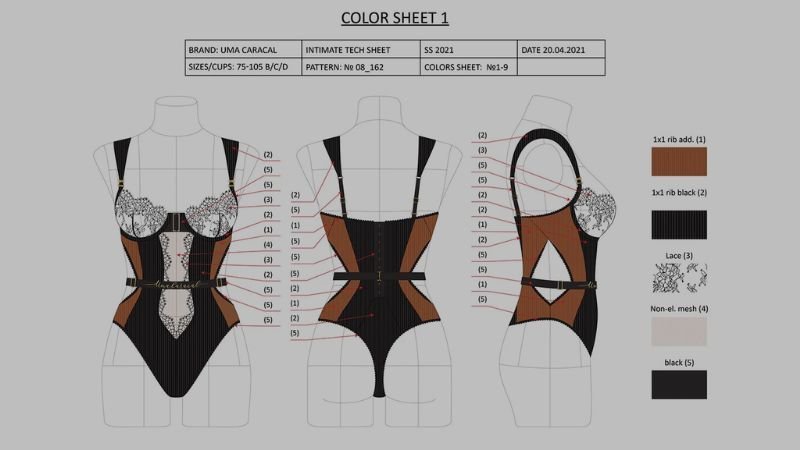
A lingerie tech pack is a technical document that explains how a product should be made. It allows the designer, pattern maker, material sourcing team, sample room, production line and quality inspector to work toward the same result.

A complete tech pack normally includes front and back technical drawings, base-size measurements, grading information, materials, component specifications, construction details, colors, labels and packaging requirements. It should also show the file version and record changes made during sampling. The main purpose of a tech pack is not to make the project look professional. Its purpose is to reduce assumptions.
A beautiful presentation may communicate the collection concept very well, but it is not necessarily a production document. If it does not explain the dimensions, materials or construction, the factory still has to make important decisions on behalf of the brand.
Even professionally prepared files can contain technical conflicts. The drawing may show an underwire bra while the bill of materials does not include an underwire. A customer may request a seamless appearance but specify a construction that requires visible seams. The size chart may belong to an earlier style, or the latest fitting comments may exist only in an email rather than in the current tech pack.
For this reason, an experienced lingerie manufacturer should review the tech pack before confirming the quotation or starting the sample. The factory needs to check whether the requested structure is workable, whether the materials can create the expected fit and whether the size range requires different components or construction methods.
A professional-looking document can still be confused. It simply looks more confident while being confused.
Five Common Ways Brands Share Product Development Information with a Lingerie Manufacturer
1. A Professional Lingerie Tech Pack
For established lingerie brands with an internal design or product development team, a professional tech pack is usually the most efficient starting point. It gives the manufacturer a defined design, size standard and material direction. It also makes quotations from different suppliers easier to compare because each factory is evaluating the same product requirements.
This route works particularly well when the brand already has its own fit standards, approved fabrics, component library and packaging system. It is also useful for products that will be sold across several markets or produced by more than one supplier.

A good tech pack should answer the questions that affect the product’s fit, appearance, performance and cost. For a bra, this may include the cup construction, foam thickness, underwire specification, wing lining, elastic width and strap size. For shapewear, it should identify compression zones, fabric direction and the required level of control.
However, even a complete tech pack should be treated as a working document, rather than an instruction that can never be questioned. The factory may discover that a specified lace does not have enough stretch for the pattern, or that the same narrow strap cannot provide suitable support across the full cup-size range.
A requested molded cup may require a new mold, while the expected order quantity may not justify the tooling cost. These are not minor production details. They influence whether the product can be made successfully and whether it can reach the intended price.
Version control also matters. During sampling, measurements, fabrics and construction details may change several times. Once a revision is approved, it should be added to the main document. Important information should not remain scattered across emails, meeting notes and WhatsApp conversations. A production team should not have to investigate six months of messages to determine whether the final strap width is 15 mm or 18 mm.
The most useful tech pack is therefore not simply the first document the customer sends. It is the final controlled record of the product that both sides have approved.
2. A Physical Sample with a Clear Modification List
For bras, shapewear and other fit-sensitive products, a physical reference sample can provide information that is difficult to communicate through drawings alone. By examining the actual garment, the manufacturer can understand the cup shape, underwire curve, center gore, wing height, strap position, foam thickness and internal support construction.
The sample also shows how the fabric stretches, how the elastic feels and how the different components work together. This is especially valuable when the appearance looks simple but the internal structure is not.

A smooth everyday bra may contain a molded cup, hidden sling, reinforced cradle, double-layer wing and different elastic tensions around the body. A lace bra that appears delicate from the outside may have a much stronger support structure underneath. Lingerie has a habit of hiding its engineering behind attractive fabric.
A physical sample alone, however, does not explain what the customer wants to change. The brand must tell the manufacturer whether the sample is a fit reference, construction reference, material reference or general style direction. Suppose a customer sends a bra and says, “Please develop something similar.” The factory still does not know whether to keep the cup shape, copy the fabric, increase the coverage, remove the side boning or reduce the price.
A clear modification document can be simple, provided that it is specific. The customer might ask the factory to keep the existing cup shape, increase the side wing by 1.5 cm, widen the shoulder straps, replace shiny microfiber with a matte fabric and extend the size range. This gives the pattern maker and sample room a defined target.
Comments such as “make it more comfortable” or “make it more premium” are much harder to execute. Comfort may involve softer elastic, a different underwire, more cup capacity or a lower center gore. Premium may refer to fabric, lace, hardware, stitching or packaging. The factory needs to know which part of the product should change and which part must remain the same.
The sample should also be marked with its actual size. A label saying only “Medium” is rarely enough for bra development. Medium according to which sizing system? Which underbust measurement? Which cup capacity? The pattern maker will eventually ask, and the tape measure will support the question.
A physical sample with detailed modification comments is often one of the most practical routes for developing structured bras, fuller-bust lingerie, nursing bras and shapewear. It gives the manufacturer a real product to examine while still allowing the brand to control the new design.
It may not be possible to reproduce every detail exactly. The original product may use exclusive lace, custom underwires, patented components or materials that are no longer available. In that case, the factory should identify alternatives that maintain the required function and visual direction. The goal should be a commercially workable product, not a blind copy of every hidden detail.
3. Product Photos or Videos
Many lingerie projects begin with product photos or videos. A customer may send screenshots from a website, several social media images or a short video showing the product on a model.
These references are useful for understanding the general category and design direction. An experienced factory can often identify whether the product appears to be cut and sewn, molded, bonded or seamless. It may also be able to estimate the visible fabric types, decorative details and approximate production complexity. This is normally enough for an initial feasibility discussion and, in some cases, a preliminary price range.

The limitation is that a photograph only shows what the camera can see. A front image may not reveal the internal cup construction, foam density, underwire shape, wing lining or hidden support panels. It cannot confirm the fabric weight, stretch recovery, elastic tension or exact measurements.
Two bras may look almost identical in a photograph while performing very differently on the body. One may use a lightweight single-layer wing, while the other has double-layer power mesh. One may contain a soft molded cup, while the other uses laminated foam with an internal support panel.
The camera sees a smooth beige bra. The factory needs to understand what is happening underneath the beige.
Photo-based development becomes more reliable when the customer provides several angles. Front, back, side and inside views can help the factory interpret the structure, while close-up photos of the cup, strap, wing and closure are also valuable. A short video may show the fabric stretch, edge finish or wearing method more clearly than a still image.
The customer should also confirm the base size, planned size range, main material direction, estimated quantity and required support level. Without this information, the factory can only quote based on assumptions.
Photos can therefore be a good starting point, but they should not remain the final production standard. Before bulk manufacturing begins, both sides still need to approve the dimensions, materials, construction, colors and physical sample. Otherwise, the brand may approve a photograph while the factory manufactures its own interpretation of what the photograph did not show.
4. AI-Generated Product Images
AI-generated lingerie designs are now common in product development inquiries. They allow brands to explore silhouettes, colors and collection ideas quickly, often before hiring a technical designer. Used as inspiration, AI images can be helpful because they can show the general mood, visual direction, lace placement or intended customer style.
The difficulty begins when the image is treated as a finished product specification.

An AI-generated bra may look convincing at first glance, but the construction often becomes less convincing when examined closely. The left strap may connect differently from the right strap. The center gore may disappear into the lace. A bodysuit may have no practical opening. An apparently seamless bra may also contain several sharply defined structural panels.
In some images, the product offers dramatic support without any visible source of support. This is impressive visually, although the laws of garment construction may request a meeting. AI is good at producing an attractive result, but it is not always concerned with how a worker will sew it, how the customer will put it on or how it will support the body.
An AI image also does not define the fabric weight, cup construction, base size, elastic tension or grading method. It does not explain which details are essential and which are simply visual effects created by the software. For these reasons, an AI image should be treated as a design concept rather than a production-ready lingerie tech pack.
The brand and manufacturer first need to identify the main elements worth keeping. The concept should then be translated into front and back technical drawings, a workable construction and an initial material plan. After the base size and size range are confirmed, the factory can review feasibility and begin physical development. This process may require compromise.
Putting an AI image into a PDF and writing “Tech Pack” on the cover does not create the missing technical information. It simply gives the image a more official folder.
For brands without an internal technical team, a capable ODM lingerie manufacturer may help convert the AI concept into a workable product. However, this is a real development service involving structure design, material selection, pattern development, fitting and sample revisions. The customer should therefore expect more technical discussion than would be required for a project based on an approved tech pack.
5. An Existing Factory Style with Customization Instructions
Not every customer needs to create a product from the beginning. A retailer, wholesaler or established brand entering a new category may choose an existing factory style as the starting point and then customize the fabric, lace, color, cup thickness, hardware, label, packaging or selected construction details.
This approach is often described as factory base-style development, ODM development or private-label customization. It is different from simply purchasing ready stock.

A factory base style may already have a tested pattern and known production method, but the final product can still use customized materials, branding, colors and packaging. Depending on the changes, the fit or size range may also be adjusted.
This development route can be faster and less risky because the factory is not beginning with an untested construction. The sample room already understands the basic pattern, and the manufacturer may have previous experience sourcing the required materials.
It is especially suitable for companies with established sales channels but limited technical development resources. A wholesaler may understand which styles sell in its market without maintaining a team of bra technicians. A chain retailer may need a commercially proven core range rather than a completely original structure.
The customer still needs to give clear instructions. “Make this more premium” is not enough. The brand should explain whether premium means softer fabric, higher-quality lace, stronger support, cleaner bonding, upgraded hardware or better packaging.
The customer should also confirm whether the existing fit is acceptable. Changing a fabric can change the fit, even when the pattern remains the same. Extending the size range may require new cups, wider straps or stronger wing materials.
A factory base style reduces development risk, but it does not remove the need for technical confirmation.
Other Materials That Can Support Product Development
Brands may also provide technical flat drawings, measurement charts, pattern files, 3D garment files, mood boards, fabric swatches or functional product briefs. These materials can be useful, but they normally support the main development method rather than replace it.
A digital pattern still needs material and construction information. A 3D garment can communicate proportions but cannot fully demonstrate cup support, elastic pressure or real fabric recovery. A mood board explains the visual direction but does not tell the sample room how to assemble the garment.

The value of these files depends on whether they answer a specific development question. Sending more files does not automatically create more clarity, particularly when the information conflicts.
Which Development Method Is Best?
There is no single method for every project. The best option depends on the product complexity, the brand’s technical resources and how much development responsibility the factory is expected to take.
| Development Method | Accuracy | Most Suitable For |
|---|---|---|
| Tech pack with physical sample | Very high | Complex custom bras, shapewear and performance products |
| Professional tech pack | High | Established brands with technical teams |
| Physical sample with modification notes | High | Fit-sensitive lingerie and sample-based development |
| Existing factory style with customization | Medium to high | Faster ODM and private-label programs |
| Product photos or videos | Medium to low | Initial evaluation and approximate quotation |
| AI-generated image alone | Low | Early concept and visual discussion |
For a complex custom bra, the strongest combination is usually a professional tech pack, a physical reference sample and clear modification comments. When a full tech pack is unavailable, a physical sample with a specific change list can still provide a reliable starting point.
For retailers and wholesalers without an internal technical team, an existing factory style may offer the best balance between customization, development time and commercial risk. Photos and AI images are useful for starting the discussion, but they require more interpretation before sampling can begin.
Why Bra Development Needs More Than a General Clothing Sketch
Bra development involves fit and support requirements that cannot be fully communicated through a general fashion drawing. A loose garment can tolerate some variation in fabric performance and measurements, while a bra fits closely to the body and distributes pressure through the cup, underband, wing and shoulder straps. A small change in one area can affect the entire wearing result.
The factory first needs to understand the base size and the planned size range. A bra developed in 75B cannot simply be enlarged evenly until it becomes 95G. As sizes increase, the construction may need wider straps, higher wings, stronger elastic, additional lining or different underwires. Larger cup sizes may also require changes to cup seams, foam molds or hook-and-eye widths.
The external design can remain consistent while the internal engineering changes.

Cup construction is equally important. A molded cup, three-piece cut-and-sew cup and wireless support cup may create similar visual shapes, but they achieve that result differently. The factory needs to understand whether the customer wants natural shaping, lift, compression, full coverage or high-impact support.
“Comfortable and supportive” is a reasonable product goal, but it is not one construction method. Support may come from the underwire, cup seams, cradle, wing lining, underband elastic or inner sling. In many bras, it comes from all of them working together.
Material information also needs to go beyond fiber composition. Two fabrics containing the same percentage of nylon and elastane can have different weights, knitting structures, stretch and recovery. One may be suitable for a soft everyday bra, while the other provides enough compression for shapewear.
The pattern and material must be developed together. Replacing rigid lace with highly stretchable microfiber without adjusting the pattern will change the fit, even when every paper pattern piece remains identical. The fabric has not read the design brief. It will behave according to its own construction.
Small components also matter. Strap width, elastic tension, hook-and-eye size and underwire shape all influence comfort and support. These details may need to change within the same size range rather than remaining identical across every size.
This is why lingerie development requires more than making the sample visually similar to the drawing. The manufacturer must understand how the product should perform on the body. A sample may look correct on a table and still fail during fitting because the cup gapes, the underwire sits on breast tissue or the wing stretches too much to provide support.
Useful fitting comments should identify where the problem occurs and how much change is needed. “The fit is wrong” gives the pattern maker very little direction, while “Reduce the upper cup opening by 0.8 cm in the base size” provides something that can be measured and corrected.
What Should a Brand Provide Before Requesting a Quotation?
A complete tech pack is not always necessary during the first inquiry. The manufacturer does, however, need enough information to understand the product and select the correct development route.
Before requesting a firm quotation, the brand should ideally provide:
- A tech pack, sample, photo or other clear product reference
- The base size and planned size range
- The main materials and required product function
- The estimated quantity per style and color
- The target market, branding and packaging requirements
- Any important fit, support, testing or launch requirements
Order quantity is particularly important because it affects material minimums, dyeing, cup molding, hardware, printing and production costs. A quotation for 500 pieces is not calculated in the same way as a quotation for 30,000 pieces. Keeping the quantity hidden does not normally improve the negotiation. It mostly encourages the costing team to make assumptions.
The brand should also explain whether it expects the factory to follow an existing specification, modify a sample, interpret a visual concept or propose an ODM solution. Each route involves a different level of technical work and sampling risk.
FAQ
Q1: Can a lingerie manufacturer develop a product without a complete tech pack?
Yes. A manufacturer may begin with a physical reference sample, product photos, technical drawings, an AI-generated concept or an existing factory style. However, the less technical information the brand provides, the more interpretation and development work the factory must complete before sampling.
Before production, the final measurements, materials, construction details, colors and packaging requirements should still be documented and approved.
Q2: Is a physical sample better than a lingerie tech pack?
A physical sample and a professional tech pack provide different information. A tech pack defines measurable requirements, while a physical sample helps the manufacturer understand the actual cup shape, fabric feel, elastic tension and internal construction.
For bras, shapewear and other fit-sensitive products, the most reliable option is often a professional tech pack combined with a physical reference sample and clear modification comments.
Q3: Can an AI-generated lingerie image be used as a tech pack?
An AI-generated image can communicate the visual direction of a product, but it cannot replace a production-ready tech pack. It normally does not define measurements, materials, seams, support construction, grading or how the garment should be assembled.
The image must first be converted into technical drawings, a workable construction, material specifications and a confirmed size range before formal sampling begins.
Q4: What information does a lingerie manufacturer need for an accurate quotation?
For a more reliable quotation, the brand should provide a clear product reference, planned size range, main materials, expected order quantity per color and style, required support or function, branding requirements and packaging details.
The quotation may remain preliminary when important information such as fabric construction, cup type, quantity or size range has not yet been confirmed.
Q5: Can a brand customize an existing factory lingerie style?
Yes. An existing factory style can often be customized through changes to the fabric, lace, colors, straps, cups, hardware, labels, sizing and packaging.
This development route is usually faster and carries less technical risk than creating a completely new structure. However, changes to materials or size ranges may still require pattern adjustments and sample approval.
Conclusion
A professional tech pack remains the clearest option for fully customized lingerie development, but it is not the only workable starting point. A physical sample with precise modification comments can be equally effective for fit-sensitive products, while an existing factory style may be more practical for retailers and wholesalers seeking a faster ODM route.
Photos and AI-generated images can communicate a design direction, but they should be converted into measurable construction, material and fit requirements before production.
From a manufacturer’s perspective, the best development file is not the longest or the most attractive. It is the one that reduces guesswork and gives the brand and factory the same understanding of the final product. When the initial information is incomplete, the right factory should not simply guess more confidently. It should identify what is missing before the first sample is made.
Send Your Tech Pack to XieSheng and Develop Your Lingerie Collection
Whether you have a complete lingerie tech pack, a physical reference sample, product photos, an AI-generated concept or only an initial product direction, XieSheng can help you identify what information is ready and what still needs technical development.
Send us your product reference, planned size range, estimated quantity and main customization requirements. Our lingerie development team will review the construction, materials and production feasibility, then recommend a practical route for quotation and sampling.Please contact us!