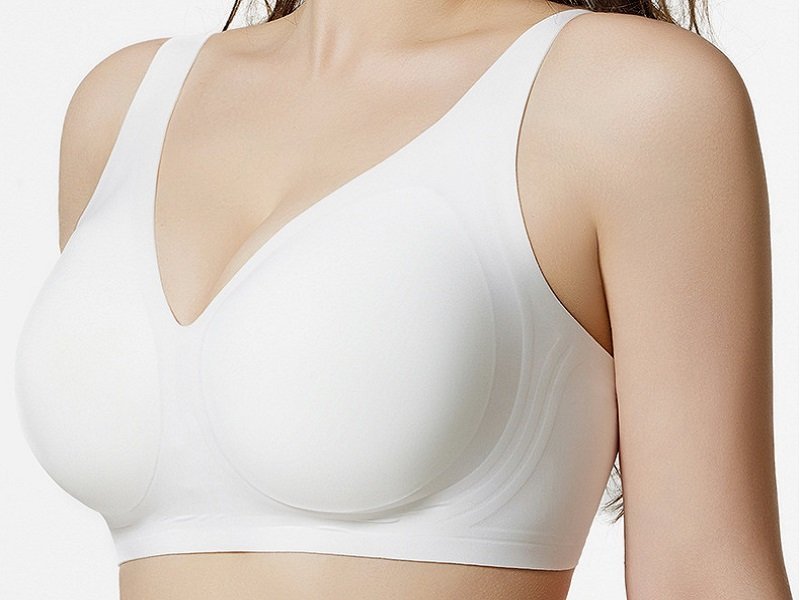
Seamless bonded lingerie first gained popularity abroad in the late 1990s through technological trials in Europe, the US, and Japan. From 2000 to 2005, it entered the high-end market on a larger scale, became more widely available to the general public after 2010, and experienced a full-scale boom after 2020, becoming a mainstream product category.
Currently, seamless bonded lingerie have become an important category in the lingerie market and it have gained traction for a good reason. This article will provide a detailed introduction to the differences between seamless bonded and traditional lingerie, common materials and manufacturing processes, reasons for their popularity, product line and production speed to help brands better understand this popular category and quickly respond to market demands.
What Are Bonded Seamless Lingerie — and How They Differ from Traditional Sewn Lingerie?
Seamless bonded lingerie, as the name suggests, are lingerie products made using a seamless bonded process, where fabric and accessories are bonded together through a special bonding technique. Its main features are the absence of visible seams on the cup wings, waistline, and bottom band, resulting in a unified, seamless design. Compared to traditional sewn lingerie, there are significant differences in structure, manufacturing process, and wearing experience.
| Comparison Area | Traditional Sewn Lingerie | Seamless Bonded Lingerie |
|---|---|---|
| Structure | Built by stitching multiple fabric pieces together, which naturally creates seam lines and more pronounced edges. | Built through one-piece molding and bonding, eliminating most seams and keeping only a few concealed seams where needed (e.g., the clasp). |
| Look Under Clothing | Seams are more likely to show under tight or thin garments, creating visible lines or marks. | Smoother, more body-hugging finish delivers an “invisible” look with minimal seam imprint. |
| Manufacturing Process | Primarily cutting, sewing, binding/edge finishing, trims & hardware assembly, and thread trimming, requiring higher sewing skill and multiple steps. | The process mainly involves laser cutting, adhesive dispensing/brushing, heat-press bonding, and cooling & shaping (with a small amount of assembly and sewing). |
| Production Scalability | Consistency can vary more with operator skill, making standardization harder at scale. | Process parameters are easier to standardize, making it more suitable for repeatable mass production. |
| Wearing Experience | Seams may rub the skin; under tight clothing they can leave marks and may cause discomfort over time. | Edgeless design reduces friction and irritation; higher fit improves comfort and supports a true “no-show” feel. |
Structurally, traditional sewn lingerie rely on stitching different fabric pieces together, inevitably resulting in seam marks and obvious edges. In contrast, seamless bonded lingerie, through one-piece molding and bonding, eliminate most seams, retaining only a few concealed seams in necessary areas (such as the clasp), resulting in a more natural, body-hugging fit.

In terms of manufacturing, traditional lingerie involve complex manufacturing processes, including multiple steps such as cutting, sewing, edging, and finishing, requiring a high level of sewing skills. The manufacturing process for seamless bonded lingerie is more challenging, relying on high-precision molding and environmentally friendly bonding techniques. Seamless lingerie manufacturing is highly technical, and the production process requires skilled technicians to precisely control key parameters such as temperature and pressure. If the parameters are incorrect, there is little room for rework. Overall: Sewing-based lingerie production involves more processes and relies more on manual labor; seamless bonded lingerie production has more complex parameters and relies more on materials and equipment.
Regarding wearing comfort, the seams of traditional sewn lingerie can rub against the skin, leaving visible marks and potentially causing discomfort over time. Seamless bonded lingerie features edgeless construction and a close-to-skin fit to deliver an “invisible” look. It also reduces friction and irritation, significantly improving comfort while creating a smooth, natural silhouette.
Materials & Bonding Process: The Technical Factors That Determine Quality
The quality of seamless adhesive bras depends primarily on two factors: the fabric materials and the bonding process. These two aspects directly affect the product’s comfort, durability, safety, and overall wearing experience.
In terms of fabric materials, softness, breathability, elasticity, and skin-friendliness must all be considered. Mainstream outer layers typically use stretch knits made from Nylon (polyamide) or Polyester blended with Spandex (elastane), and the level of stretch varies with the fiber composition. These fabrics offer a smooth, refined surface, strong elastic recovery, and good abrasion resistance, and they are more likely to maintain clean, flat edges and a streamlined silhouette after bonding and heat-pressing. These are also the two fabrics we use most often.

The bonding process is a critical technical aspect, with the main processes including hot-melt adhesive bonding and cold bonding. Hot-melt adhesive bonding involves heating the adhesive film to a high temperature, causing it to melt and penetrate the fabric fibers. Upon cooling, a strong bond is formed, offering high bonding strength and good washability, making it suitable for large-scale industrial production. Cold bonding, on the other hand, uses specialized adhesives at room temperature to bond the fabrics. This process requires higher precision and better preserves the original softness of the fabric, making it suitable for high-end customized products. Furthermore, the molding process also affects quality. High-precision molding equipment ensures uniform cup curvature and a perfect fit to the human breast curve, preventing issues such as gaps or shifting of the cups. It also guarantees consistent product dimensions, providing stable support for OEM/ODM mass production.
Why it’s trending: comfort-first demand + expectations for “invisible under clothing”
The rise of seamless adhesive bras is essentially the result of the combined effect of upgraded consumer demand and the refinement of dressing scenarios, with the core focus on the two major demands of “comfort” and “invisibility”.
Comfort has become the core driving force. With changing lifestyles, consumers’ demands for underwear have shifted from simple support and shaping to a focus on both comfort and health. The friction and tightness caused by the seams of traditional sewn bras are no longer suitable for extended wear, casual wear at home, or light exercise. Seamlessly bonded bras, with their seamless design, soft fabric, and high fit, effectively reduce skin pressure and friction, minimizing discomfort even after prolonged wear. Meanwhile, the breathable fabric improves the warm, stuffy environment in the chest area, aligning with modern consumers’ pursuit of “lightweight lingerie.”

The desire for “invisible lingerie” has also accelerated its popularity. Today, consumers increasingly prefer clean, streamlined silhouettes. As body-hugging dresses, fitted knits, and lightweight tops become more common, the stitch lines, cup-edge impressions, side-wing marks, and back-closure bumps of traditional bras are more likely to show through, reducing the overall look and feel. Seamless bonded lingerie, with its integrated construction and invisible edges, creates a smoother outline and a lower visual profile—helping prevent styling embarrassment from daily commuting to photoshoots, dinners, and vacations—so it has been adopted and popularized more quickly.
Seamless bonded underwear product line
Built on the core advantages of seamless bonding, brands can expand their product lines around specific wearing scenarios, target groups, and functional needs—balancing versatility with differentiation. This approach fits OEM/ODM bulk customization while covering a broader range of consumer occasions and wear requirements.
In the bra category, seamless bonding is commonly used for wire-free comfort styles, lightweight molded “no-show” bras, detachable-strap/multiway bras, and even certain underwired constructions (such as bonded underwire channels and invisible reinforcement in key stress areas). The core value is a closer, smoother fit at the cup edge, wings, and back band—reducing pressure marks and visible bra lines. In the panties category, laser-cut edges combined with bonded leg openings and waistbands are the most typical application, covering multiple silhouettes such as briefs, boyshorts, and thongs, with the goal of delivering a no-dig, no-roll, low-profile wearing experience.

In shapewear and base-layer products, seamless bonding best highlights the advantage of being “thin yet supportive.” For example, it is widely used in high-waist shaping briefs, shaping shorts, bodysuits, camisoles, and close-fitting tops. Bonding can secure reinforcement panels and create invisible finishes, improving stability and a smoother appearance without adding bulk. It also works well for niche categories such as nursing bras or plus-size support styles—by reducing skin friction, enhancing close-to-body fit, and adding stronger invisible reinforcement in closure or high-stress areas to balance functionality with comfort. For brands and buyers, this means the same process logic can be scaled across a coordinated product range, creating a consistent “invisible, no-show” selling point and making it easier to drive set purchases and frequent new launches.
Faster Production, More Consistent Products: Built to Accelerate Time-to-Market
One of the core advantages of bonded seamless bra construction is shorter production lead times and more consistent products—helping brands respond to market demand faster and gain a competitive edge.
From an efficiency standpoint, bonded seamless lingerie significantly streamlines the manufacturing workflow. As mentioned earlier, seamless bonded lingerie uses process routes such as molded shaping and automated bonding, reducing reliance on traditional sewing and multiple stitching operations, making the production workflow more standardized and repeatable. Once the style structure and key parameters are confirmed, it can move more efficiently into scalable mass production and stable delivery—helping brands shorten the timeline from sampling to bulk, respond faster to replenishment orders, and bring new products to market sooner to capture selling windows and trend opportunities.

From a product-consistency perspective, once the fabric system and key process parameters (such as temperature, pressure, dwell time, and cooling/setting) are validated, the production line can operate within a clearly defined “process window,” reducing variation caused by differences in individual operator handling. At the same time, structural bonding and invisible edge finishing are delivered through equipment- and process-controlled steps, making edge lay-flat performance, silhouette smoothness, and overall garment appearance consistency more predictable and controllable.
FAQS
Seamless bonded vs traditional sewn lingerie—what’s the biggest difference?
Sewn lingerie relies on stitching multiple panels, which naturally creates seam lines and bulk. Bonded lingerie reduces most stitch lines and uses bonding + molding to achieve a flatter, more “no-show” finish.
What materials are most commonly used for seamless bonded lingerie?
The mainstream choice is Nylon (polyamide) or Polyester blended with Spandex (elastane) for smoothness, stretch recovery, and abrasion resistance. Depending on the product positioning, linings or specific zones may use softer, skin-friendly fabrics.
Which product categories can apply seamless bonding technology?
It’s widely used in wire-free bras, panties (laser-cut + bonded waist/leg), shapewear, base-layer tops, and niche styles like nursing or plus-size support (with reinforced high-stress areas).
Why can bonded lingerie support faster time-to-market?
Once the fabric system and bonding parameters are validated, workflows can be more standardized and repeatable, enabling efficient scaling, stable delivery, and faster replenishment response—helping brands capture key selling windows.
Conclusion
In recent years, seamless bonded lingerie has become increasingly popular thanks to its comfort and “no-show” performance, and it has grown into a mainstream product category.
Understanding the differences between seamless bonded and traditional sewn lingerie—along with the common materials and manufacturing processes, scalable product line extensions, and the advantages in production speed and consistency—helps brands capture market opportunities and bring products to market faster.