Girls swimwear is no longer only about cute prints and bright colors. For brands, a successful girls swimwear style must balance retail appeal with comfort, sun protection, fit, safety, MOQ planning, and bulk production feasibility.
As parents pay more attention to children’s comfort, skin protection, and practical wear, girls swimwear has become a valuable category for brands developing seasonal swimwear, resortwear, family holiday collections, and retail programs.

This guide reviews the market value of girls swimwear, the most popular girls swimwear styles, and the key development points brands should consider before starting sampling or bulk production.
Why Girls Swimwear Has Strong Market Value for Brands
Girls swimwear has strong market value because it belongs to the growing kids swimwear segment, supports multiple product styles, and meets repeated seasonal demand from beach travel, swimming lessons, resorts, and water park use.
The global swimwear market continues to grow, supported by beach vacations, recreational swimming, water sports, resort travel, and stronger consumer interest in functional swimwear. Market research also shows that kids swimwear is no longer treated as a small extension of adult swimwear. It has become an independent product category with its own fit, safety, fabric, and design requirements.
For brands, girls swimwear is especially valuable because it offers more style variety than many other children’s swimwear categories. A complete girls swimwear collection can include UPF 50+ rash guard swimsuits, classic one-piece swimsuits, rash guard bikini sets, tankinis, ruffle swimsuits, sporty colorblock designs, and swim dresses. This gives brands more space to build seasonal stories, print collections, family matching programs, and premium sun-protection ranges.

Girls swimwear also performs well from a merchandising perspective. Retailers in the US and Europe often build dedicated girls swimwear categories covering one-piece swimsuits, rash guards, tankinis, bikinis, swim shorts, frill details, UPF fabrics, and chlorine-resistant styles. This shows that girls swimwear is not only trend-driven, but also commercially important for assortment planning.
For B2B buyers, the value of girls swimwear comes from three areas: repeat seasonal demand, strong visual merchandising potential, and functional product upgrades. Parents need swimwear for holidays, pools, beaches, swimming lessons, and water parks, while brands can differentiate their collections through fabric performance, sun protection, fit, print design, and safe decorative details.
What Makes a Girls Swimwear Style Popular?
A popular girls swimwear style is not defined by appearance alone. In the B2B market, a style becomes valuable when it meets both consumer expectations and production requirements.
Parents usually look for girls swimwear that is safe, comfortable, easy to wear, and suitable for real activities such as beach holidays, swimming lessons, outdoor pools, water parks, and family resorts. Children, on the other hand, care more about color, print, comfort, and whether the style feels fun to wear.
For brands and retailers, popularity also needs to be judged by commercial performance. A good style should support clear sizing, stable fabric performance, manageable MOQ, safe decoration, repeatable bulk production, and strong product photos for online sales.
This is why the best girls swimwear styles are usually not the most complicated designs. They are the styles that combine visual appeal, practical function, child-friendly comfort, and scalable production.
What Are the Most Popular Girls Swimwear Styles?
UPF 50+ Long Sleeve Rash Guard Swimsuits
UPF 50+ long sleeve rash guard swimsuits are one of the strongest girls swimwear directions for outdoor use. They are especially suitable for beaches, resorts, water parks, outdoor pools, and family holiday collections because they provide more coverage than regular swimsuits.
For parents, the main value is sun protection. Long sleeves help cover the shoulders, arms, back, and chest, while UPF 50+ fabric gives the product a clear functional selling point. This makes the style easier to position as protective, practical, and parent-friendly.
For brands, this style has strong commercial value because it combines performance with retail appeal. It can be developed as a long sleeve one-piece swimsuit, a zip-front surf suit, a high-neck rash guard swimsuit, or a rash guard set with matching bottoms.

During development, brands should treat UPF 50+ as a tested performance feature, not just a marketing phrase. Fabric structure, color, stretch level, wet condition, and testing support can all affect UV protection performance. Zipper comfort, neckline coverage, sleeve movement, and seam softness should also be checked before bulk production.
Classic One-Piece Swimsuits
The classic girls one-piece swimsuit remains one of the most stable and widely accepted swimwear styles. It is simple, practical, easy to wear, and suitable for many retail channels, including supermarkets, department stores, e-commerce brands, children’s boutiques, and swim lesson programs.
One-piece swimsuits are popular because they offer secure coverage and a clean silhouette. For younger girls, parents often prefer one-piece styles because they stay in place more easily during swimming, running, and beach play. For brands, this style is also easier to use as a core seasonal product.
A classic one-piece swimsuit can be developed in many directions, such as basic solid colors, all-over prints, cross-back designs, sporty thin straps, light ruffle details, colorblock panels, or simple cutout details for older girls.

From a manufacturing perspective, the biggest risk is fit. A one-piece swimsuit must balance torso length, crotch comfort, shoulder strap position, neckline coverage, and leg opening tension. If the body length is too short, the swimsuit may pull at the shoulder or crotch. If it is too long, the garment may wrinkle, sag, or collect water.
Rash Guard Bikini Sets
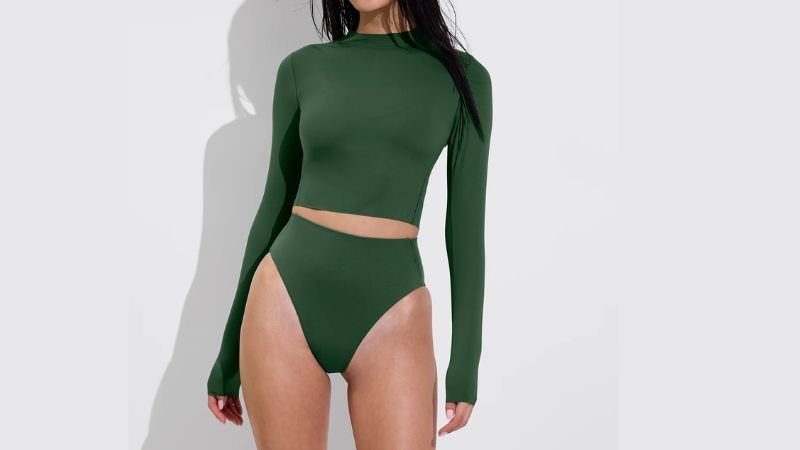
Rash guard bikini sets are a strong option for brands that want a two-piece girls swimwear style while keeping the design practical and age-appropriate. This style usually includes a short sleeve or long sleeve rash guard top with a bikini bottom, swim brief, or matching short.
Compared with traditional bikinis, rash guard bikini sets provide better upper-body coverage. Compared with one-piece swimsuits, they are easier to put on and take off, which can be useful for older girls, beach holidays, resortwear, and water park use.
The commercial advantage of this style is that it offers both flexibility and protection. Parents may feel more comfortable choosing a two-piece set when the top has rash guard coverage. Children may also like the freedom of movement and the more modern look.

For brands, the main development focus should be top length, bottom coverage, waistband comfort, and fabric recovery. The top should not ride up during movement, and the bottom should remain secure without being too tight. If the style is designed for outdoor use, UPF fabric can further increase its retail value.
Tankini and Mix-and-Match Swim Sets
Tankini sets are popular because they sit between one-piece swimsuits and bikinis. They provide more coverage than a bikini but more dressing flexibility than a one-piece swimsuit.
A tankini usually includes a swim top and a matching bottom. The top can be designed as a camisole, racerback, longer coverage top, or rash guard-inspired shape. The bottom may be a brief, swim short, skirted bottom, or matching printed piece.
For brands, tankinis offer strong merchandising flexibility. They allow different tops and bottoms to be mixed within one color story or print range. This can make a collection look richer and give consumers more styling choices.

However, tankinis also create more SKU complexity. If a brand develops too many prints, colors, sizes, and bottom options at the same time, MOQ pressure can increase quickly. Matching tops and bottoms also require careful planning in cutting, packing, inventory, and size ratios.
Ruffle and Frill Swimsuits
Ruffle and frill swimsuits remain popular because they give girls swimwear a cute, playful, and photo-friendly look. They are especially common in younger girls’ collections, boutique swimwear, holiday ranges, and family matching programs.
Ruffles can be placed on the shoulders, straps, neckline, waist, back, or leg openings. When used properly, they add visual softness and make the product more attractive in online product images. This can help improve click-through rate and visual appeal for e-commerce brands.
However, ruffle design needs careful control in children’s swimwear. Large layered ruffles, heavy skirt effects, hard trims, loose decorations, beads, sequins, or charms can create safety, comfort, and production risks. Heavy ruffles may absorb water and restrict movement, while poorly finished edges may rub the skin.

For B2B brands, the goal is not to remove all decorative details. The goal is to make decoration safe, soft, lightweight, secure, and suitable for water activities. A well-developed ruffle swimsuit should look cute but still remain comfortable, washable, and practical for bulk production.
Sporty Colorblock Swimsuits
Sporty colorblock swimsuits are becoming an important direction for girls swimwear because they look modern, practical, and active. Instead of relying on heavy decoration, this style creates visual impact through contrast panels, stripes, piping, zipper details, and athletic design lines.
This direction works well for swim lessons, school swimming programs, active beachwear, sports retail, and performance-inspired kids swimwear. It feels cleaner and safer than styles with many small decorative parts, while still offering a strong visual identity.
For brands, sporty colorblock styles are easier to position as practical and durable. They can be developed as one-piece swimsuits, zip-up swimsuits, short sleeve surf suits, rash guard sets, or tankini sets with contrast panels.

From a production perspective, the key challenges are panel matching, seam placement, colorfastness, and fabric consistency. If dark and light colors are combined in one garment, brands should check whether color bleeding may occur after washing, swimming, or chlorine exposure. Different color panels should also have similar stretch recovery to avoid distortion after wear.
Swim Dresses and Skirted Swimsuits
Swim dresses and skirted swimsuits remain popular in younger girls’ swimwear because they offer a cute, feminine look with extra coverage. These styles often work well for vacation collections, resortwear, family photos, and gift-oriented product ranges.
The main selling point is visual appeal. A simple attached skirt, light A-line shape, or soft ruffle hem can make a swimsuit look more playful and parent-friendly. For younger age groups, this type of style can perform well in bright colors, floral prints, fruit prints, and summer holiday themes.
However, swim dresses require more careful development than basic one-piece swimsuits. If the skirt is too long, too layered, or too heavy, it may absorb water and restrict movement. Large skirts may also create more drag in water, which can affect comfort and activity.

Brands should control skirt length, fabric weight, lining, and seam comfort. The skirt should enhance the look of the product without making the garment difficult to swim or play in. Swim dresses can be attractive retail products, but they should be designed for real water use, not only for product photos.
How Should Brands Choose the Right Girls Swimwear Style?
Choosing the right girls swimwear style depends on the target market, age group, retail channel, price positioning, and wearing scenario. A product for beach holidays may need different coverage and fabric performance than a product for indoor swimming lessons. A supermarket program may need simpler construction and stable MOQ, while a boutique brand may prefer more distinctive details and prints.
| Style | Best For | Main Selling Point | Development Risk |
|---|---|---|---|
| UPF 50+ Rash Guard Swimsuit | Beach, water park, resort | Sun protection and coverage | UPF testing, zipper comfort |
| Classic One-Piece | Retail basics, school swim, supermarkets | Stable fit and broad appeal | Torso grading and strap comfort |
| Rash Guard Bikini Set | Older girls, resortwear, beachwear | Coverage with two-piece flexibility | Top length and bottom coverage |
| Tankini Set | E-commerce, mix-and-match programs | Fit flexibility and styling options | SKU and MOQ complexity |
| Ruffle Swimsuit | Boutique, younger girls, holiday collections | Cute visual appeal | Decoration safety and bulk consistency |
| Sporty Colorblock | Active swim, swim lessons, sports retail | Practical and modern look | Panel matching and colorfastness |
| Swim Dress | Toddlers, vacation collections | Feminine look and extra coverage | Water weight and movement restriction |

For brands developing a first girls swimwear collection, it is usually better to start with a focused range. A practical starter collection may include one UPF 50+ rash guard style, one classic one-piece swimsuit, one tankini or rash guard set, and one visual style such as ruffle or colorblock.
This helps control MOQ, reduce sampling complexity, and test customer response before expanding into more prints, colors, and silhouettes.
What Should Brands Consider Before Developing Girls Swimwear?
Popular styles still need proper technical development. Before starting sampling, brands should confirm the product direction clearly with the manufacturer.
Before starting a girls swimwear project, brands should confirm:
- Target market and age group
- Wearing scenario: beach, pool, resort, water park, or swim lessons
- Fabric safety and colorfastness requirements
- Whether UPF 50+ testing is needed
- Size range and fit approval process
- Decoration safety and trim risk
- Print, color, and MOQ plan
- Bulk production timeline and inspection requirements
For B2B buyers, the best product is not simply the most fashionable style. It is the style that fits the target customer, meets safety expectations, can be produced efficiently, and supports repeat orders.

An experienced manufacturer can help brands review fabric, construction, trims, size grading, color planning, and bulk production feasibility before the design is fully locked. This early review can reduce sampling revisions, avoid production delays, and make the final collection more commercially workable.
FAQ About Popular Girls Swimwear Styles
What are the most popular girls swimwear styles for brands?
Popular girls swimwear styles include UPF 50+ rash guard swimsuits, classic one-piece swimsuits, rash guard bikini sets, tankini sets, ruffle swimsuits, sporty colorblock swimsuits, and swim dresses. These styles combine retail appeal with practical wearing value.
Are UPF 50+ rash guard swimsuits worth developing?
Yes. UPF 50+ rash guard swimsuits are valuable for outdoor beach, resort, pool, and water park collections. They provide stronger coverage and give brands a clear sun-protection selling point for parents.
Are one-piece swimsuits still popular for girls?
Yes. One-piece swimsuits remain one of the most stable girls swimwear styles because they are practical, secure, easy to wear, and suitable for many retail channels.
What is the difference between a tankini and a rash guard bikini set?
A tankini usually has a longer swim top with a matching bottom, while a rash guard bikini set usually includes a rash guard top with a bikini bottom or swim brief. Tankinis focus more on flexible coverage and styling, while rash guard sets often focus more on sun protection and active use.
Are ruffle swimsuits suitable for children?
Ruffle swimsuits can be suitable if the ruffles are soft, lightweight, secure, and not too bulky. Brands should avoid heavy layered ruffles, detachable decorations, sharp trims, or small accessories for younger children.
How can brands reduce development risk when making girls swimwear?
Brands can reduce risk by choosing suitable fabrics, confirming UPF requirements early, reviewing size set samples, controlling decorative details, planning MOQ by print and color, and working with a manufacturer before the design is fully finalized.
Conclusion
Girls swimwear has strong commercial value because it combines seasonal demand, visual merchandising potential, functional product upgrades, and multiple style directions. UPF 50+ rash guard swimsuits, classic one-piece swimsuits, rash guard bikini sets, tankinis, ruffle swimsuits, sporty colorblock designs, and swim dresses all offer different opportunities for brands.
However, the best-selling style is not always the most decorative one. For B2B buyers, the right girls swimwear style should match the target age group, wearing scenario, fabric performance, safety requirements, MOQ plan, and retail channel.
By selecting the right styles and working with an experienced manufacturer early, brands can develop girls swimwear collections that are attractive, comfortable, safer for children, and easier to scale for bulk production.
Develop Your Girls Swimwear Collection with XIESHENG
Planning a girls swimwear collection for your brand?
XIESHENG supports swimwear brands with fabric selection, sample development, size grading, UPF-focused styles, print planning, and bulk production. Whether you are developing rash guard swimsuits, one-piece swimsuits, tankini sets, ruffle styles, sporty colorblock swimwear, or swim dresses, we can help turn your concept into a production-ready collection.
Share your design, target market, size range, and expected order quantity with us. We will review your project and suggest a practical development solution.
Contact us to start your girls swimwear project.