Introduction
Kids swimwear development requires more than attractive prints and smaller sizing. For brands selling to parents, retailers, or online consumers, every fabric, trim, fit detail, and production decision can affect safety, comfort, return rates, and brand trust.
From fabric safety and UPF 50+ protection to decorative details, size grading, and MOQ planning, small development mistakes can quickly become costly production risks. This article highlights six key risks brands should avoid when developing kids swimwear and explains how early planning with the right manufacturer can help create safer, more commercially successful products.

Is Kids Swimwear Just a Smaller Version of Adult Swimwear?
No. One of the most common mistakes in kids swimwear development is treating it as a scaled-down version of adult swimwear. Children move differently, grow quickly, and often wear swimwear for more active situations such as beach play, swimming lessons, water parks, and family holidays. This means the garment must support movement without slipping, twisting, rubbing, or creating pressure marks.
Adult swimwear can sometimes prioritize body shaping, fashion lines, or visual impact. Kids swimwear should prioritize comfort, secure coverage, skin-friendly construction, and easy dressing. A swimsuit that looks correct on a flat pattern may still fail during movement if the neckline, leg opening, waist elastic, crotch length, or shoulder strap position is not properly adjusted for children’s body proportions.
From a production perspective, kids swimwear requires careful size grading. The difference between toddler, preschool, and older children’s body proportions is not only height or chest width. Torso length, shoulder slope, waist position, and leg opening all affect real wearing comfort. If the pattern is developed only by reducing an adult block, the final product may look acceptable in photos but perform poorly in actual wear.

| Development Point | Adult Swimwear Focus | Kids Swimwear Focus |
|---|---|---|
| Fit priority | Shape, silhouette, visual appeal | Movement, coverage, comfort |
| Pattern grading | Body curve and support | Growth proportion and activity |
| Fabric tension | Body-hugging fit | Comfortable recovery without pressure |
| Decoration | Fashion impact | Safety, durability, no irritation |
| Testing focus | Fit and appearance | Fit, safety, colorfastness, stretch recovery |
A professional kids swimwear brand should review the product not only as a garment, but as a wearing scenario. Before sampling, the brand should understand whether the style is for swim lessons, beach retail, resortwear, family matching sets, rash guard programs, or supermarket volume programs.
Does Fabric Safety Matter in Kids Swimwear?
Yes. Fabric safety is one of the most important factors in kids swimwear development, and it should be considered before style, print, or price. Children’s skin is more delicate than adults’ skin, with a thinner protective barrier and higher sensitivity to friction, moisture, and chemical irritation.
Because swimwear is worn directly against the skin and often stays wet for long periods, poor fabric selection can quickly lead to comfort complaints, skin redness, itching, or irritation.
Kids swimwear is also exposed to more demanding wearing conditions than many other garments. Pool water contains chlorine and disinfectants, while seawater contains salt, sand, and microorganisms.
If the fabric is low quality, poorly dyed, or not properly tested, it may become rough after soaking, lose elasticity, bleed color, or release unwanted chemical residues. For children’s products, this is not only a quality issue but also a safety and brand trust issue.
Low-grade swimwear fabrics may contain excessive formaldehyde, azo dyes, heavy metals, fluorescent agents, or other restricted substances. These risks become more serious when the garment is worn close to the skin in wet conditions and under body temperature.
Poor colorfastness is another common problem. If the fabric bleeds after swimming or washing, the dye may remain on the child’s skin and cause irritation. Loose fibers, weak seams, or unstable fabric surfaces can also increase discomfort during active movement.
For this reason, qualified kids swimwear should use skin-friendly, high-stretch nylon/spandex or polyester/spandex fabrics with stable dyeing, good colorfastness, chlorine resistance, seawater resistance, and soft hand feel after soaking.

The fabric should recover well after stretching, dry quickly, and remain comfortable during swimming, beach play, or water park activities. For B2B brands, fabric safety should be checked together with lining, elastic, printing ink, labels, trims, and sewing thread, because all of these components may touch the child’s skin.
Material certifications can also support buyer confidence. For example, OEKO-TEX® STANDARD 100 is a textile label for materials tested for harmful substances from yarn to finished product. However, brands should avoid assuming that one material certificate automatically covers the full finished garment. Elastic, lining, printing ink, heat-transfer labels, sewing thread, and trims may also need to be reviewed depending on the market and buyer requirements.
| Fabric Safety Point | Why It Matters in Kids Swimwear | What Brands Should Check |
|---|---|---|
| Skin-friendly fabric | Children’s skin is more sensitive to friction and irritation | Soft hand feel before and after soaking |
| Chemical safety | Swimwear is worn close to the skin in wet conditions | Restricted substance testing if required |
| Colorfastness | Poor dyeing may bleed onto skin or other garments | Colorfastness to water, rubbing, washing, and chlorine |
| Chlorine and seawater resistance | Pool and beach use can damage unstable fabrics | Fabric stability after repeated exposure |
| Stretch recovery | Poor recovery causes deformation and poor fit | Elasticity and recovery after stretching |
| Lining quality | Light colors may become transparent when wet | Wet coverage and comfort |
| Surface stability | Loose fibers or rough fabric can irritate skin | Smooth surface and secure construction |
In one kids swimwear project, the customer originally selected a light-colored fabric mainly because the print looked fresh and attractive. During sample review, we found that the fabric became slightly transparent when wet and the hand feel became less soft after soaking.
Before bulk production, we adjusted the lining and recommended retesting the lighter colorway. This helped the brand reduce the risk of customer complaints after launch.
For children’s swimwear brands, fabric approval should never be based only on appearance. A fabric that looks good when dry may perform very differently after swimming, stretching, washing, and sun exposure. The safer approach is to review fabric performance, testing requirements, and bulk production stability before confirming the final material.
Is UPF 50+ Important for Children’s Swimwear?
Yes. UPF 50+ is an important performance feature for children’s swimwear, especially for outdoor swimming, beachwear, resortwear, and water park collections. UPF stands for Ultraviolet Protection Factor, which measures how effectively a fabric blocks ultraviolet rays.
A UPF 50+ fabric blocks at least 98% of UV radiation and allows less than 2% to pass through, making it one of the highest levels of sun protection in textile products.
However, UPF should not be treated as only a marketing phrase. Fabric structure, yarn type, color depth, stretch level, wet condition, and finishing treatment can all affect UV protection. AATCC TM183 is one test method used to determine ultraviolet radiation blocked or transmitted by textile fabrics intended for UV protection, including procedures for dry or wet specimens.
For children, sun protection is more important than in adult swimwear. Children’s skin is thinner and more sensitive, with less natural protection against UV exposure. During outdoor swimming or beach activities, they may stay under the sun for long periods, and short exposure can already cause redness, sunburn, or peeling.
In the long term, repeated UV exposure can also increase skin-related health risks, which is why many parents now actively look for kids swimwear with clear UPF protection.
Water-related environments can make UV exposure stronger. At outdoor pools, beaches, and open-air water parks, sunlight is reflected by water, sand, and light-colored surfaces. This means children may receive UV exposure not only from direct sunlight but also from reflected rays. For this reason, regular swimwear fabric may not be enough for products positioned as outdoor kids swimwear.
Compared with sunscreen, UPF swimwear provides a more stable physical barrier. It does not need to be reapplied, is not easily washed away by water, and can reduce the need for sunscreen on covered areas.
This is especially useful for children with sensitive skin or for parents who want easier sun protection during swimming and travel. However, UPF swimwear should not be presented as complete protection. Areas not covered by the garment, such as the face, neck, hands, and legs, still need hats, shade, and suitable children’s sunscreen.

For brands, UPF 50+ should be planned according to the actual product scenario. Outdoor pools, beaches, resorts, and water parks should prioritize UPF 50+ fabrics, especially for rash guards, long-sleeve swimsuits, surf suits, and full-coverage styles. For indoor heated pools without direct sunlight, UPF may be less critical, while fabric safety, chlorine resistance, stretch recovery, and comfort should remain the main focus.
| Wearing Scenario | UPF Requirement | Product Development Focus |
|---|---|---|
| Beach and seaside | UPF 50+ recommended | UV protection, saltwater resistance, colorfastness |
| Outdoor swimming pool | UPF 50+ recommended | Chlorine resistance, stretch recovery, sun protection |
| Water park | UPF 50+ recommended | Coverage, durability, comfort, quick drying |
| Resortwear collection | UPF 50+ adds value | Fabric performance and retail selling point |
| Indoor heated pool | Can be more flexible | Fabric safety, chlorine resistance, comfort |
Brands should also understand that UPF performance can decrease over time. Fabric stretching, repeated washing, chlorine exposure, seawater, and aging may reduce the protective effect. Therefore, if a brand wants to make a UPF 50+ claim, the fabric should be properly tested, and the claim should be clearly supported by reliable material data.
For children’s swimwear brands, UPF 50+ is not just a marketing label. It is a functional feature connected to product safety, parental trust, and brand positioning. When developing kids swimwear, brands should confirm UPF requirements early with the manufacturer, because fabric structure, color, stretch level, coverage design, and testing standards can all affect the final protection performance.
Can Decorative Details Create Safety Risks in Kids Swimwear?
Yes. Decorative details can create serious safety risks in kids swimwear if they are not carefully controlled during product development. Unlike adult swimwear, children’s swimwear should not rely heavily on loose trims, small accessories, long ties, or sharp decorative parts. Children are more active in water, more likely to pull or bite small details, and less able to recognize potential hazards during play.
Small detachable accessories are one of the highest-risk areas. Three-dimensional flowers, rhinestones, sequins, beads, cartoon charms, tassels, and similar decorations may look attractive on a sample, but they can fall off during wearing, washing, swimming, or pulling. For younger children, loose small parts may create choking or ingestion risks. Hard detached pieces can also scratch the skin or injure the feet and hands during pool or beach activities.
Long cords, drawstrings, and tie straps should also be treated with caution. Necklines, waists, skirt hems, and hood areas should avoid long loose ties because they may become tangled during sliding, swimming, climbing, or water play. This can create risks of strangulation, entrapment, falling, or restricted movement. For younger age groups, a cleaner and more fixed construction is usually safer than decorative tie details.
The CPSC has determined that hood and neck drawstrings on children’s upper outerwear in sizes 2T to 12 present a strangulation hazard, and waist or bottom drawstrings in certain children’s sizes must meet specific limitations.

Hard or sharp trims can also cause discomfort and injury. Metal buckles, hard plastic patches, sharp-edged decorations, and stiff appliqués may scratch or press against the skin when children swim, run, sit, or play with other children. In kids swimwear, trims should be soft, lightweight, securely attached, and free from sharp edges.
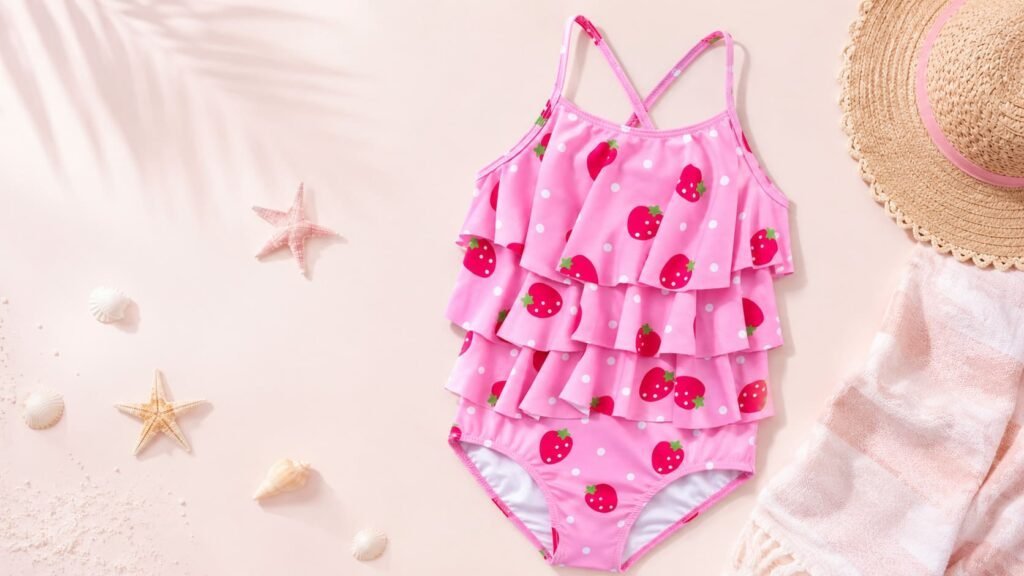
Complex layered skirts and large ruffles should also be reviewed carefully. While they may improve visual appeal, bulky tulle skirts, heavy ruffles, or multi-layer decorative panels can absorb water, become heavier after soaking, and restrict movement. In active water scenarios, this may affect comfort, swimming ability, and emergency movement. Extra folds and seams may also trap sand, dirt, or moisture, increasing hygiene concerns.
For B2B brands, decorative details should be evaluated by age group, wearing scenario, attachment strength, washing durability, and safety requirements before bulk production. A design that looks cute in photos may not be suitable for toddlers, swim lessons, water parks, or large retail programs.
A practical age-based approach can help reduce development risk:
- Under 3 years old: Use minimal decoration. Avoid small parts, long cords, loose trims, hard accessories, and 3D decorations. Simple, flat, and smooth designs are safer.
- 3–7 years old: Flat prints, soft heat transfers, and limited decorative effects are more suitable. Avoid loose accessories and long tie straps. If ties are necessary, they should be short, fixed, and without free-hanging ends.
- 7 years and above: Simple decorative details may be acceptable, but brands should still avoid detachable small parts, sharp trims, and heavy layered structures.
In one kids swimwear development project, the customer wanted to add small decorative charms and layered ruffles to make the style look more playful. After reviewing the target age group and wearing scenario, we recommended removing the charm and reducing the ruffle volume. The final design kept a cute retail look but became safer, lighter, and easier to produce consistently in bulk.
For children’s swimwear, decoration should never be added only for visual appeal. Every trim, tie, ruffle, and seam must be reviewed from a safety, comfort, washing, and bulk production perspective. The best kids swimwear designs are not necessarily the most decorative ones, but the ones that balance commercial appeal with safe and practical wear.
Does Poor Fit Increase Returns in Kids Swimwear?
Yes. Poor fit is one of the most common reasons for returns in kids swimwear. For brands selling through e-commerce, marketplaces, supermarkets, or retail chains, sizing problems can directly increase return rates, reduce profit margins, lower customer reviews, and weaken repeat purchases.
Kids swimwear has a higher fit risk than adult swimwear because children’s body proportions change quickly. For example, children aged 3–5 may grow several centimeters within one year, and choosing size only by age can easily lead to mismatch. A swimsuit that is too tight may cause shoulder pressure, crotch discomfort, skin rubbing, or restricted movement. A swimsuit that is too loose may collect water, slip from the shoulders, sag in the waist, or create safety concerns during swimming.
Fit problems are even more obvious in online sales because parents cannot try the product before buying. They rely heavily on size charts, product photos, and fit guidance. If the size table is unclear or the grading is inconsistent, customers may order the wrong size, return the product, leave negative reviews, or switch to another brand. For children’s swimwear, fit is not only a comfort issue. It directly affects conversion, return rate, brand trust, and customer lifetime value.
From a production point of view, poor fit usually comes from four areas: inaccurate pattern development, weak size grading, unsuitable fabric stretch, or incorrect elastic tension. Even when the sample looks good in one middle size, the full size range may not perform consistently. Smaller sizes may become too tight in the shoulder or crotch, while larger sizes may lose shape after stretching or water exposure.

| Fit Problem | Customer Complaint | Production Cause | Brand Risk |
|---|---|---|---|
| Shoulder too tight | “It hurts / leaves marks” | Strap length or armhole grading issue | Negative reviews and returns |
| Torso too short | “Pulls at the crotch” | Incorrect body length grading | High return rate in one-piece styles |
| Waist too loose | “Slips down in water” | Weak elastic or poor waist tension | Safety and comfort concern |
| Leg opening too tight | “Rubs the skin” | Elastic tension too strong | Skin irritation complaints |
| Size chart unclear | “Size does not match” | Age-only sizing or inconsistent grading | Wrong-size orders and low repeat purchase |
| Fabric loses recovery | “Fits well at first, then becomes loose” | Poor stretch recovery after water/washing | Quality complaints after use |
To reduce return risk, brands should use more precise size planning. For kids swimwear, height-based sizing is usually more practical than simple S/M/L sizing or age-only sizing. A clearer size structure, such as height plus chest and waist measurements, helps parents choose more accurately. For younger children, combining age and height can also improve decision-making, for example: “3 years / 100 cm.”
Brands can also improve fit performance through growth-friendly construction. Soft waist elastic, controlled stretch recovery, suitable shoulder strap length, and comfortable leg openings can help cover small changes in body growth without making the garment too tight or too loose. This is especially important for children aged 3–7, where growth speed and activity level are both high.
Practical fit-control steps include:
- Use height-based sizing instead of only S/M/L.
- Add chest, waist, and body length measurements to the size chart.
- Review size set samples before bulk cutting.
- Check shoulder, crotch, waist, and leg opening tension.
- Test fabric recovery after stretching, washing, and soaking.
- Provide clear fit guidance for online customers.
- Keep size grading consistent across styles in the same collection.
In one kids swimwear project, the middle size sample looked acceptable, but the size set review showed that the smaller sizes were too tight at the shoulder and the larger sizes had weak waist recovery after soaking. Before bulk production, we adjusted the strap length, waist elastic tension, and body length grading. This helped improve comfort across the full size range and reduced the risk of size-related returns.
For children’s swimwear brands, fit should be treated as a return-control strategy, not just a sample approval step. Accurate sizing, growth-friendly elasticity, and full size set review can help reduce returns, protect profit margins, and improve customer confidence. In a category where parents care about both comfort and safety, a well-fitted swimsuit is one of the strongest drivers of repeat purchase.
Can Prints and Colors Affect Kids Swimwear MOQ?
Yes. Prints and colors can significantly affect MOQ in kids swimwear development. Many brands focus on the garment MOQ, but the real production MOQ is often influenced by fabric dyeing, printing, elastic color, lining color, label production, packaging, and colorway planning.
Custom prints usually require artwork preparation, strike-off approval, color matching, and minimum fabric printing quantities. If the order quantity is too small and the print has several colorways, the cost per piece can increase quickly. This is why kids swimwear projects with many prints, sizes, and colorways may become commercially difficult even when the garment design looks simple.
Color also affects risk. Light colors may need better lining to avoid transparency. Neon colors may require more careful colorfastness review. Dark colors may have stronger visual stability but still need testing for rubbing and bleeding. For family matching swimwear, adult and kids styles may use the same print, but the fabric base, width, and cutting efficiency can be different.
| MOQ Factor | Why It Matters | Buyer Recommendation |
|---|---|---|
| Custom print | Printing mills may have minimum fabric quantities | Start with fewer print designs |
| Multiple colorways | Each color may require separate dyeing or printing | Build volume around core colors |
| Small size range + many colors | Quantity becomes fragmented | Combine sizes strategically |
| Matching family sets | Different styles may use fabric differently | Plan cutting efficiency early |
| Special lining color | Extra material sourcing MOQ | Use standard lining where possible |
| Packaging by size/color | More handling and sorting | Confirm packing method before order |

For a first kids swimwear launch, brands should avoid over-fragmentation. Instead of developing six prints across eight sizes with low quantity per design, it may be more practical to start with two or three strong prints, core sizes, and a clear reorder plan.
This approach helps the supplier control fabric purchasing, production efficiency, color consistency, and delivery risk. It also helps the brand test the market without creating unnecessary development complexity.
Should Brands Work with a Kids Swimwear Manufacturer Early?
Yes. Brands should involve the manufacturer before the design is fully locked. Many production risks can be prevented if the factory reviews the style at the design stage instead of after the tech pack is finalized.
An experienced kids swimwear manufacturer can advise on fabric selection, lining, elastic tension, print feasibility, UPF claim control, stitching method, size grading, MOQ planning, and packaging structure. This does not mean the factory replaces the brand’s designer. It means the factory helps turn the design into a commercially workable product.
Early supplier involvement is especially valuable when the project includes:
- UPF 50+ claims
- Custom prints
- Long-sleeve rash guards
- Family matching collections
- Toddler sizes
- Decorative trims
- Large retail compliance requirements
- Multiple markets such as the US, EU, UK, or Australia
For B2B swimwear brands, the right supplier should be able to discuss not only price, but also production risk. If a supplier only quotes quickly without reviewing fabric, construction, safety, testing, and MOQ logic, the project may face problems later.
A good manufacturer should ask practical questions: What market will this be sold in? What age group is the style for? Does the brand need UPF testing? Are there buyer compliance requirements? Is the print custom or from existing fabric? What is the expected first bulk quantity? These questions help protect both the brand and the factory.
What Should Brands Check Before Starting a Kids Swimwear Project?
Before starting a kids swimwear project, brands should prepare a clear development checklist. This helps reduce sampling rounds, avoid unclear expectations, and improve quotation accuracy.
Kids Swimwear Development Checklist
| Area | What to Confirm Before Sampling |
|---|---|
| Target market | US, EU, UK, Australia, Middle East, or other market |
| Age group | Toddler, kids, junior, or family matching |
| Product type | Bikini, one-piece, rash guard, swim shorts, surf suit |
| Fabric | Nylon/spandex, polyester/spandex, recycled fabric, lining |
| UPF requirement | Whether UPF 50+ claim is needed and whether testing is required |
| Print method | Digital print, screen print, sublimation, solid dye |
| Safety review | Trims, cords, bows, metal parts, labels, elastic |
| Size range | Core sizes and size grading requirements |
| MOQ planning | Quantity by style, color, print, and size |
| Testing | Colorfastness, stretch recovery, UPF, chemical safety, buyer tests |
| Packaging | Retail packaging, hangtag, barcode, size sticker, polybag |
| Timeline | Sample approval, size set, PP sample, bulk production, shipment |
For brands working with large retailers, this checklist should be completed before final quotation whenever possible. A lower price without clear specifications is not always the best price. If fabric, testing, packaging, and trims are unclear, the final cost may change later.
The best development process is structured and transparent: design review, fabric selection, sample development, fitting, size set review, testing support, pre-production sample, bulk production, final inspection, and shipment. This process reduces risk and helps brands protect delivery schedules.
FAQ
Q1: What should brands check first when developing kids swimwear?
Brands should first check fabric safety, fit, size range, target market, and wearing scenario. Kids swimwear is worn directly against the skin and often used in pools, beaches, and water parks, so the product should be reviewed for comfort, safety, colorfastness, stretch recovery, and bulk production feasibility before sampling.
Q2: Is UPF 50+ necessary for all kids swimwear?
No. UPF 50+ is highly recommended for outdoor swimwear, beachwear, rash guards, surf suits, and water park styles. It provides strong textile-based sun protection and is especially valuable for children’s collections. For indoor pool swimwear, UPF may be less critical, while fabric safety, chlorine resistance, comfort, and stretch recovery should remain the main focus.
Q3: What decorative details should be avoided in kids swimwear?
Brands should be careful with small detachable accessories, rhinestones, beads, charms, long cords, loose ties, sharp trims, and heavy layered ruffles. These details may create choking, scratching, entanglement, discomfort, or movement restriction risks. For younger children, flat prints, soft heat transfers, and clean construction are usually safer choices.
Q4: How can brands reduce size-related returns in kids swimwear?
Brands can reduce returns by using height-based sizing, adding chest, waist, and body length measurements, reviewing full size set samples, and checking elastic tension at the shoulder, waist, crotch, and leg openings. Clear online fit guidance also helps parents choose the correct size and reduces wrong-size orders.
Conclusion
Kids swimwear development carries more production risk than many brands expect. Fabric safety, UPF 50+ claims, decorative details, fit accuracy, print and color planning, and late manufacturer involvement can all affect product safety, return rates, MOQ, delivery, and retail performance.
For brands, avoiding these six risks starts before sampling. The product should be reviewed as a complete wearing scenario, not only as a design sketch. Materials, trims, size grading, colorways, testing requirements, and bulk production feasibility all need to be checked early.
A well-developed kids swimwear collection should be safe for children, practical for parents, reliable for retailers, and workable for mass production. By identifying these risks early, brands can reduce costly revisions, improve product quality, and build swimwear programs that are easier to scale season after season.
Start Your Kids Swimwear Project With Xiesheng
As an experienced swimwear and intimate apparel manufacturer, xiesheng help brands turn design ideas into safer, more practical, and production-ready kids swimwear collections.
Share your design, target market, size range, and expected order quantity with us. Our team can review your project and suggest the most suitable fabric, construction, MOQ, and development approach.
Contact us to start your kids swimwear project.