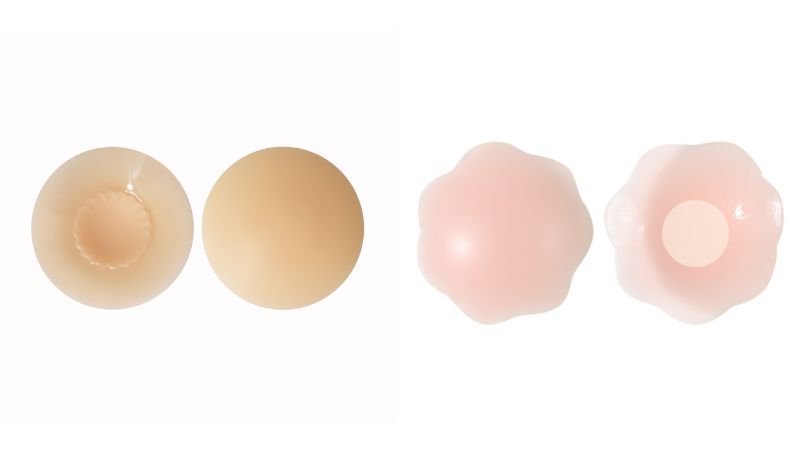
When developing a nipple cover collection, lingerie brands often have two options to consider. One is thin, lightweight and discreet under clothing, while the other is thicker, softer and has a jelly-like feel. These are solid silicone and liquid silicone nipple covers, two popular styles with different textures, coverage and wearing experiences.
For brands, these differences affect more than how the product feels in the hand. They influence nipple coverage, wearing comfort, product positioning and manufacturing costs. A thin cover may appeal to customers looking for a barely noticeable finish, while a thicker, softer design may suit those who prioritize a fuller feel and more substantial coverage.
This article compares solid vs. liquid silicone nipple covers, helping lingerie brands understand their construction, wearing performance and sourcing considerations before choosing the right products for their collections.
What Are Solid Silicone Nipple Covers?
Solid silicone nipple covers are generally marketed as products made with a solid silicone rubber material that is shaped and cured into a flexible cover. In the nipple cover market, the term often refers to thin, lightweight designs with a relatively flat profile.
For brands developing a minimalist invisible lingerie collection, thin solid silicone nipple covers offer a discreet and lightweight product option.
Their structure allows manufacturers to produce covers with a thin center and tapered edges, depending on the mold design and material formulation. The aim is to provide sufficient nipple coverage without creating unnecessary bulk under clothing.

Thin silicone covers can also be flexible enough to follow the natural curves of the breast. However, flexibility depends on the material’s hardness, thickness and construction rather than the word “solid” alone.
One consideration is the balance between thickness and coverage. A cover that is too thin or translucent may not conceal the nipple as effectively as customers expect, particularly under light-colored or close-fitting clothing.
For buyers, thinness should never be evaluated independently from coverage. A successful design needs to balance a low-profile appearance with sufficient opacity and a smooth edge transition.
Solid silicone nipple covers can be a practical addition to brands focusing on everyday invisible lingerie, especially when the target consumer prefers a simple, lightweight product with minimal visible bulk.
What Are Liquid Silicone Nipple Covers?
Liquid silicone nipple covers are commonly promoted for their soft, flexible feel and smooth finish. In some product collections, they feature a thicker, fuller structure with a texture often described as jelly-like.

Compared with thin solid silicone covers, these thicker liquid silicone designs can offer a softer, more cushioned feel and more substantial coverage. The additional material in the center may help conceal nipple projection, while a carefully designed tapered edge can reduce the transition between the cover and the surrounding skin.
The jelly-like texture is another selling point. It gives the cover a soft, flexible feel that some brands may prefer for premium or comfort-focused collections. However, it is important to understand what “liquid silicone” actually means.
In material manufacturing, Liquid Silicone Rubber (LSR) refers to a flowable silicone material before curing. Once processed and cured, it becomes a solid, flexible elastomer rather than remaining liquid inside the product.
Some nipple covers marketed as liquid silicone may also use soft silicone gel formulations or other constructions. Buyers should therefore confirm the actual material and manufacturing method instead of relying only on the product name.
A thicker cover may provide additional opacity, but its weight and edge design also require attention. If the center is too bulky or the edges are not properly tapered, the outline may become visible under tight or lightweight garments.
For lingerie brands, the appeal of these products lies in combining a soft, jelly-like feel with effective coverage and an attractive finished shape. The right balance depends on the brand’s target consumers and the clothing occasions for which the product is intended.
Solid vs. Liquid Silicone Nipple Covers: Key Differences
The most noticeable differences between thin solid silicone nipple covers and thicker liquid silicone designs are their thickness, texture and overall wearing experience.
However, these characteristics describe the product constructions being compared here. They are not fixed properties of every product manufactured from high-consistency or liquid silicone rubber. The table below summarizes the main differences that lingerie brands should consider.
| Comparison Factor | Solid Silicone Nipple Covers | Liquid Silicone Nipple Covers |
|---|---|---|
| Product Structure | Thin, flexible silicone construction | Thicker, fuller construction with a soft, jelly-like feel |
| Thickness | Thin, low-profile design | Thicker, cushioned design |
| Texture | Flexible, smooth and lightweight | Soft, cushioned and jelly-like |
| Weight | Often lighter when dimensions and material density are comparable | May be heavier due to greater material volume |
| Nipple Coverage | Depends on center thickness, opacity and color | Thicker centers may provide more substantial coverage |
| Invisible Appearance | Low-profile structure can minimize bulk under clothing | Depends heavily on center thickness and tapered-edge design |
| Skin Conformity | Influenced by flexibility, dimensions and product construction | Influenced by softness, thickness, weight and product construction |
| Manufacturing | Commonly associated with HCR compression molding | May use LSR molding or a separate silicone-gel/film-encapsulation process, depending on construction |
| Cost | Depends on material consumption, mold design and production quantities | Depends on material consumption, manufacturing method and production quantities |
| Product Positioning | Thin, discreet everyday collection | Soft, fuller-coverage or jelly-feel collection |

What Do These Differences Mean for Brands?
For brands targeting customers who want nipple covers to feel light and look discreet under clothing, a thin solid silicone design may be a suitable starting point. Its main advantage is the low-profile structure rather than an assumption that solid silicone is inherently more invisible.
For brands looking to develop a product with a softer, fuller feel, a thicker liquid silicone design may be more appropriate. The jelly-like texture and additional center thickness can create a different wearing experience and help distinguish the product within a collection.
Neither option is automatically better. A thinner cover is not always less effective at concealing the nipple, and a thicker cover is not necessarily more comfortable or less visible. Those outcomes depend on the final dimensions, material formulation, edge design and actual wearing conditions.
For this reason, brands should compare physical samples rather than make product decisions based only on silicone terminology.
How Do Thickness and Texture Affect Wearing Performance?
Customers rarely choose nipple covers based on the type of silicone used during manufacturing. What matters most is how the product looks and feels when worn.
For brands, understanding the connection between product construction and wearing performance is essential when deciding which design belongs in their collection. Thickness, softness and invisible appearance are three factors that deserve particular attention.
Thickness and Nipple Coverage
The center of a nipple cover provides much of its concealment, while the surrounding area helps it blend with the breast.
A thin cover can be effective when the material has sufficient opacity and the center is designed to conceal nipple projection. However, a very thin or translucent design may provide less coverage than expected.
A thicker nipple cover may offer greater opacity and help smooth the appearance of the nipple, depending on its shape and material characteristics.
That does not mean maximum thickness is always desirable.
Too much thickness can increase bulk and make the cover more noticeable under fitted garments.
For brands, the key is to balance center thickness with coverage requirements rather than simply make the entire cover thicker.
The finished result should be evaluated under different fabric types and colors, particularly where the product is intended for everyday clothing.
Softness and Wearing Comfort
Softness is an important part of the consumer experience, but it is not determined by the liquid or solid silicone label alone.
A thin solid silicone cover may feel light and flexible, while a thicker jelly-like version may provide a softer, cushioned sensation.
Both experiences can appeal to different customers.
The comfort of a nipple cover also depends on its dimensions, weight, flexibility and ability to follow the natural contour of the breast.
For example, a very soft cover may still feel less comfortable if it is unnecessarily heavy or poorly sized. Similarly, a thinner cover may feel comfortable because of its light weight, even if its material is less gel-like.
Brands should therefore evaluate softness and overall wearing comfort as separate characteristics.
Material samples can show how the silicone feels, but finished-product samples are needed to understand how that material performs in use.

Invisible Appearance Under Clothing
One of the main reasons consumers purchase silicone nipple covers is to achieve a smooth appearance without visible bra lines.
However, invisible performance is influenced by more than the thickness of the cover.
The shape of the edge is particularly important.
A nipple cover with a relatively thick center and gradually tapered edges may blend more smoothly into the surrounding breast than a thinner design with an abrupt edge.
This principle is also reflected in published nipple-cover design concepts, including a patent describing a thicker center and tapered perimeter to help conceal nipple projection while reducing the visible outline.
The patent illustrates a design approach rather than proving the performance of every commercial product.
For brands, edge thickness and center thickness should be specified separately.
When reviewing samples, it is useful to compare the covers under fitted T-shirts, lightweight tops and other garments relevant to the target market.
This can reveal differences that are difficult to judge from product photographs alone.
How Are Solid and Liquid Silicone Nipple Covers Manufactured?
Manufacturing methods can influence nipple cover thickness, dimensional consistency, tooling requirements and production costs.
However, the commercial names “solid silicone” and “liquid silicone” do not always identify the exact manufacturing process. Brands should confirm the material and construction with their suppliers before making technical comparisons.
Solid Silicone Processing
One commonly used material is High Consistency Rubber (HCR), a gum-like silicone compound that can be processed through compression molding.
In a typical workflow, the silicone compound is mixed with pigments and prepared in measured portions. The material is then placed into a heated mold, where pressure and heat shape and cure it into the required nipple cover design. After demolding, excess material is trimmed and the covers are inspected before any required adhesive application, protective film covering and packaging.
The manufacturing process begins with silicone mixing and pigmentation, followed by cutting the material into measured portions. The prepared silicone is then shaped and cured through compression molding. After demolding, excess material is trimmed, and the covers undergo quality inspection before adhesive application (if required), protective film covering and final packaging.
For thin nipple cover designs, mold geometry and material distribution help control diameter, curvature, center thickness and edge taper. Material flexibility and dimensional consistency must also be checked against the approved sample.
Liquid Silicone Processing
Liquid Silicone Rubber (LSR) is generally supplied as a flowable, two-component material. In a typical LSR molding process, the components are metered and mixed before being introduced into a mold, where they cure into a flexible silicone product.
The LSR manufacturing process begins with mixing the two liquid silicone components (A and B) in the required ratio. The mixed material is then injected into a heated mold, where it cures into the desired nipple cover shape. After demolding, the edges are trimmed and the covers undergo quality inspection, followed by adhesive application (if required), protective film covering and final packaging.
According to silicone material producer Elkem’s technical overview of liquid silicone rubber, LSR differs from high-consistency silicone in its flowable form before curing. The finished LSR product is not a liquid.
Some thicker, jelly-like nipple covers use silicone gel or a film-encapsulated construction instead. Such products may involve film cutting, forming a pouch, material filling, sealing, shaping and inspection. This is a separate construction from conventional LSR injection molding, so the exact process should be confirmed with the supplier rather than inferred from the term “liquid silicone.”
Why Manufacturing Matters for Brands
Different manufacturing approaches can affect mold development, thickness control, surface finish, production efficiency and consistency between batches.
For thin solid silicone nipple covers, particular attention should be paid to material distribution and edge thickness. For thicker, jelly-like designs, buyers should also assess softness, shape, weight and the finished edge profile.
A more automated process does not automatically result in a lower unit cost. Manufacturing cost depends on the complete project, including material selection, product dimensions, mold requirements, production quantities, finishing and packaging.
When comparing quotations, brands should confirm that suppliers are pricing the same construction, thickness, material specification and packaging. Otherwise, a lower quotation may reflect a different product rather than a more competitive manufacturing process.
Which Silicone Nipple Covers Are Right for Your Brand?
Choosing between solid and liquid silicone nipple covers starts with understanding what your customers want from the product.
Some consumers prioritize thinness and an almost unnoticeable feel under clothing. Others may prefer a softer, more substantial cover that provides additional concealment.
For lingerie brands, the goal is to match the construction to the intended wearing experience and retail positioning.
Choose Thin Solid Silicone Nipple Covers for a Discreet Collection
Thin solid silicone nipple covers may be suitable for brands developing lightweight invisible lingerie products.
They can fit a collection focused on everyday wear, minimal bulk and smooth styling under clothing.
When sourcing this type of cover, buyers should pay attention to center opacity, edge tapering and product flexibility.
A thin appearance is valuable only when the cover still provides the level of concealment expected by the customer.
Choose Thicker Liquid Silicone Nipple Covers for a Soft, Jelly-Like Feel
Thicker liquid silicone nipple covers may suit brands looking for a fuller construction and a soft, cushioned texture.
These features can help position the product within a comfort-focused or premium-feel collection.
However, the thicker structure should still be evaluated for weight, fit and visibility under clothing.
A soft, jelly-like feel is an attractive product feature, but it should not be used as a substitute for evaluating the actual wearing performance.

Should Your Brand Offer Both?
Brands do not necessarily need to choose only one type.
A collection can include both thin nipple covers for discreet everyday styling and thicker jelly-like covers for consumers who prefer a fuller feel or greater center coverage.
For example, the two constructions could support separate product ranges:
Thin Invisible Collection: Designed around a low-profile appearance, lightweight construction and discreet wear.
Soft Jelly Collection: Developed around a softer, more substantial feel and fuller center construction.
Whether offering both is commercially worthwhile depends on customer demand, retail positioning and inventory requirements.
Before confirming a new collection, brands should request product samples and compare the options against a consistent specification.
<text strong>Important specifications to confirm before bulk ordering include:</text>
- Center and edge thickness: Evaluate both measurements separately to balance coverage and invisible appearance.
- Diameter, shape and weight: Confirm the dimensions and weight that suit your target customers.
- Material and construction: Identify the actual silicone formulation and manufacturing process.
- Adhesive and wearing performance: Confirm relevant skin-contact requirements and evaluate the finished product.
- Color and opacity: Compare available skin tones and how they appear under different garments.
- Mold, MOQ and packaging: Review available molds, customization requirements, minimum quantities and packaging options.
Physical samples are essential. Two nipple covers may look similar in catalog photographs but feel and perform differently once worn.
A structured sampling process helps brands compare materials, establish product specifications and reduce differences between approved samples and bulk production.
FAQ
Q1: What is the difference between solid and liquid silicone nipple covers?
Solid silicone nipple covers can be made in thin, lightweight designs, while liquid silicone nipple covers can feature a thicker, softer, jelly-like construction. However, solid and liquid silicone are also processing terms, and the actual thickness and feel depend on the product design and material formulation.
Q2: Are liquid silicone nipple covers softer than solid silicone nipple covers?
Some thicker liquid silicone designs have a softer, more cushioned feel, but this is not a universal material rule. Silicone hardness, formulation and product thickness all influence softness, so brands should compare physical samples.
Q3: Which type is more invisible under tight clothing?
Thin covers may create less overall bulk, but edge design and coverage are equally important. A thicker cover with well-tapered edges may also produce a smooth appearance, depending on the garment and product construction.
Q4: Do solid and liquid silicone nipple covers use the same adhesive?
They may use similar or different skin-contact adhesive systems, depending on the design. The silicone material category alone does not determine adhesive performance, so buyers should evaluate the finished product’s adhesion and care requirements.
Q5: Can brands customize the thickness and shape of silicone nipple covers?
Yes, thickness, diameter, shape and edge profile can be considered during OEM/ODM development, subject to material and manufacturing feasibility. Custom molds, minimum quantities and sampling costs should be confirmed with the manufacturer before
Conclusion
Solid and liquid silicone nipple covers can serve different purposes within an invisible lingerie collection.
Thin solid silicone designs may suit customers looking for a lightweight, low-profile product, while thicker liquid silicone designs may appeal to those who prefer a softer, jelly-like feel and more substantial coverage.
Neither is universally better. The right choice depends on thickness, edge design, softness, coverage and the needs of your target customers.
Before placing a bulk order, compare finished samples rather than relying on material names alone. Confirm the actual construction and establish clear product specifications with your manufacturer to develop nipple covers that fit your brand’s positioning.
Develop Custom Silicone Nipple Covers for Your Brand
At XS Lingerie, we provide OEM and ODM manufacturing support for silicone nipple covers and other invisible lingerie accessories. We help brands explore product options and evaluate customization requirements, including thickness, shape, size, color, adhesive construction and private-label packaging.
Whether you are developing a thin invisible nipple cover or a thicker, jelly-like design, share your reference samples, target quantities and product requirements with us. Our team can help assess available designs, sampling options, MOQ and production feasibility to develop a suitable manufacturing solution for your collection.