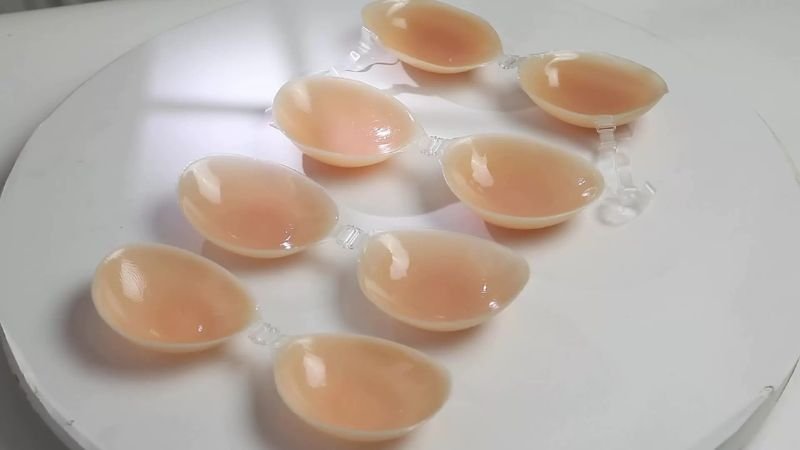
When sourcing silicone bras, nipple covers and other invisible lingerie products, brands often receive different material options and quotations from manufacturers. Some suppliers recommend medical-grade silicone, while others offer regular silicone at a lower price. For buyers, the question is whether the higher material cost is necessary and what difference it makes to the finished product.
Silicone bras and nipple covers are worn directly against the skin, so material selection affects more than price. Softness, skin-contact safety, durability and consistency between production batches all need to be considered. However, medical-grade silicone is not automatically the best choice for every product, and regular silicone is not necessarily unsuitable for skin contact.

Understanding these differences helps lingerie brands set clearer material requirements, evaluate supplier quotations and avoid paying for unnecessary specifications or overlooking potential quality risks.
This article explains the differences between medical-grade and regular silicone, helping lingerie brands choose suitable materials, verify supplier documentation and make better sourcing decisions before bulk production.
What Is Medical-Grade Silicone?
Medical-grade silicone refers to silicone materials developed and evaluated for specific medical applications, with defined requirements for material composition, quality control and biological safety. It is commonly used in products that require direct contact with the human body.
For silicone bra and nipple cover brands, medical-grade silicone is often considered when developing products intended for prolonged skin contact. Buyers may choose to evaluate these materials when skin-contact compatibility, material consistency and supporting safety documentation are important to their product positioning.
Many medical silicone formulations use platinum curing, which avoids the characteristic decomposition byproducts associated with peroxide curing. However, platinum-cured silicone is not automatically medical-grade. The material’s actual formulation, intended use and relevant test evidence must also be considered.
Another important factor is biocompatibility, which refers to how a material interacts with the body under its intended conditions of use. For silicone bras and nipple covers, buyers should pay particular attention to relevant skin irritation and sensitization evaluations. Standards such as ISO 10993 may provide useful testing references, but the results must be applicable to the actual material and intended skin-contact conditions.
When sourcing medical-grade silicone for intimate apparel, brands should request clear material specifications and relevant test reports rather than relying solely on a supplier’s medical-grade claim. The silicone cup material and any separate skin-contact adhesive must also be evaluated according to their respective functions.
What Is Regular Silicone?
Regular silicone is a general commercial description rather than a standardized material grade. It can refer to a wide range of silicone formulations used in consumer products, textiles, electronics, household goods and industrial applications.
Some formulations use platinum-catalyzed addition curing, while others use peroxide curing or different processing technologies. The curing method alone does not determine whether the finished silicone is suitable for direct skin contact. General-purpose silicone may also vary in hardness, transparency, elasticity, fillers, pigments and surface properties.

For lingerie applications, some commercially available silicone formulations may be suitable for skin contact when their composition and finished-product performance have been appropriately evaluated. Others may not meet the requirements of a particular product or target market.
The important distinction is not simply medical-grade versus regular silicone, but whether the selected material meets the product’s actual performance and safety requirements.
Medical-Grade Silicone vs. Regular Silicone: Key Differences
The following comparison focuses on material specifications, quality control and purchasing requirements rather than assuming that one category is always safe and the other is not.
| Comparison Factor | Medical-Grade Silicone | Regular / General-Purpose Silicone |
|---|---|---|
| Intended application | Developed for specified medical applications | Developed for various commercial or industrial applications |
| Material formulation | Controlled according to intended medical use and supplier specifications | Varies according to product requirements and supplier |
| Curing system | May use platinum curing or another suitable process | May use platinum, peroxide or other curing systems |
| Biocompatibility evidence | Evaluated according to relevant medical application requirements | Depends on formulation and intended use |
| Skin-contact suitability | Must be assessed for the specific application | May be suitable when supported by appropriate evidence |
| Manufacturing controls | May involve additional medical-use material and process controls | Depends on manufacturer and material specification |
| Traceability | Often supported by defined documentation and change controls | Depends on supplier quality management |
| Material cost | May carry additional qualification and quality-control costs | Wide cost range depending on formulation and processing |
The comparison highlights an important purchasing principle: a more expensive silicone grade does not automatically deliver better performance in every lingerie product. Brands should evaluate the material against their actual design and manufacturing requirements.
How Silicone Curing Systems Affect Material Quality
The curing process is one factor that influences silicone properties and processing requirements. Two widely used systems are platinum-catalyzed addition curing and peroxide curing.
Platinum-Cured Silicone
Platinum-cured silicone uses a platinum catalyst to facilitate crosslinking through an addition-curing reaction. A key advantage of this process is that it does not generate the characteristic peroxide decomposition byproducts associated with peroxide curing.
Depending on the formulation, platinum-cured silicone can offer good clarity, flexibility and controlled physical properties. However, this does not mean the finished material contains no residual substances or that the platinum catalyst has been completely consumed.
The composition and extractable substances of the finished silicone still depend on the raw materials, additives and manufacturing process.
Peroxide-Cured Silicone
Peroxide curing uses organic peroxide compounds to initiate crosslinking. During curing, peroxide decomposition can produce byproducts that may need to be reduced through suitable processing or post-curing procedures.
The type and amount of residual substances depend on the peroxide system, processing conditions and finished-material treatment.
Peroxide-cured silicone should not automatically be classified as unsafe or unsuitable for skin contact. Its suitability must be established through the appropriate material specification and evaluation.

Why the Curing System Is Not the Only Quality Indicator
For lingerie brands, focusing exclusively on whether a supplier uses platinum or peroxide curing may overlook other important quality factors.
These include:
- Silicone formulation and additives
- Hardness and elasticity
- Tear resistance
- Surface finish
- Residual and extractable substances
- Processing consistency
- Finished-product construction
A well-controlled formulation should be assessed according to its intended use rather than judged by curing terminology alone.
Silicone Material vs. Skin-Contact Adhesive: Why the Difference Matters
This distinction is particularly important for sticky bras, silicone nipple covers and other adhesive lingerie products. The silicone used to form a cup or pad is not necessarily the same material as the adhesive layer that attaches the product to the skin.
A reusable silicone bra may contain a molded silicone cup and a separate skin-contact adhesive system. Likewise, a fabric adhesive bra may use a textile or foam-based cup combined with a silicone-based, acrylic-based or other suitable adhesive.
Boob tape commonly uses a fabric or film backing with a skin-contact adhesive rather than a molded silicone body. For these products, the performance of the adhesive layer depends on factors such as:
- Adhesive formulation
- Initial tack and peel behavior
- Adhesive-to-substrate compatibility
- Skin-contact suitability
- Sweat and oil exposure
- Cleaning and repeated-use requirements
Even if the silicone cup uses a material developed for demanding applications, that alone does not guarantee strong adhesion or repeated-use performance. For example, a molded silicone cup may retain its softness and shape while the adhesive layer gradually loses tack because of surface contamination or repeated wear.
Brands should evaluate the cup material and the adhesive system separately, then test their performance together as a finished product. This prevents material certifications from being confused with actual adhesive quality.
Which Silicone Should Lingerie Brands Choose?
The appropriate silicone grade depends on the product category, construction, wearing conditions and target market. Instead of automatically requesting medical-grade silicone for every product, buyers should establish the required performance first.
Silicone Bras and Adhesive Bras
For silicone bras, brands should consider the physical properties of the cup material alongside the skin-contact adhesive system. Important specifications may include silicone hardness, flexibility, shape retention, surface feel and compatibility with the selected adhesive.
Where prolonged direct skin contact is expected, suitable material safety documentation and finished-product evaluation become particularly important. Reusable products also need testing of adhesive performance after cleaning and repeated use.
A medical-grade material specification may be relevant to certain customer requirements, but the intended application and supporting evidence should determine whether it is necessary.
Silicone Nipple Covers
Silicone nipple covers are often worn directly against the skin and may be designed for either reusable or single-use applications. Buyers should evaluate softness, edge thickness, flexibility, surface quality and the material’s suitability for the intended skin-contact conditions.
For adhesive versions, the adhesive formulation and removal experience are equally important. A premium reusable nipple cover requires more than a soft silicone material. The finished product must also maintain acceptable performance after handling, cleaning and storage.

Boob Tape and Fabric-Based Adhesive Products
Boob tape generally uses a textile or film backing with an adhesive layer. In this case, the adhesive chemistry and backing construction may be more relevant than the medical-grade versus regular silicone comparison.
Brands should confirm the adhesive’s intended skin-contact use, compatibility with the backing material, expected wear duration and removal characteristics. This illustrates why one silicone purchasing specification cannot be applied to every invisible lingerie product.
Non-Adhesive Silicone Components
Some lingerie products use silicone as an internal component, such as molded inserts or cushioning elements. For these applications, the buyer should consider whether the silicone directly contacts the skin, whether it is enclosed within another material and what physical performance is required.
Material selection should reflect these conditions rather than assuming that every silicone component needs the same grade.
Certifications and Compliance Documents: What Do They Actually Prove?
Material documentation is essential in B2B sourcing, but different standards address different requirements. A certificate should not be treated as universal proof that a silicone product is safe for every application.
ISO 10993: Biological Evaluation
The ISO 10993 series addresses biological evaluation of medical devices and their materials.
Relevant parts may include:
- ISO 10993-5: In vitro cytotoxicity testing
- ISO 10993-10: Skin sensitization testing
- ISO 10993-23: Irritation testing
These standards can be relevant technical references where appropriate, but their application must match the product’s intended use. A single test result should not automatically be described as complete medical-grade certification.
FDA 21 CFR 177.2600: Food-Contact Rubber Articles
FDA 21 CFR 177.2600 concerns rubber articles intended for repeated use in food-contact applications. It is not a general certification for repeated skin contact and does not establish that a silicone bra or nipple cover is approved for prolonged wear.
Buyers should therefore avoid using food-contact compliance as a substitute for relevant skin-contact evaluation.
OEKO-TEX® STANDARD 100
OEKO-TEX® STANDARD 100 is a harmful-substance certification system for textiles and eligible associated components. Product Class II covers products intended for direct skin contact, such as underwear.
However, a pure silicone accessory should not automatically be assumed eligible for this certification. Applicability and certificate coverage should be confirmed for the actual material or finished product.
EU REACH Requirements
For products sold in the European Union, buyers should confirm compliance with applicable chemical restrictions under REACH. These restrictions may concern substances used in materials, mixtures or finished articles.
The European Chemicals Agency explains how restrictions apply to relevant chemicals and products. A supplier statement such as “REACH compliant” should be supported by documentation appropriate to the actual materials and applicable restrictions.
For brands, the practical question is not how many certificates a supplier can display, but whether the documents accurately cover the materials, components and finished products being purchased.
How to Verify Silicone Quality from Suppliers
A structured supplier verification process is more reliable than choosing materials based only on promotional descriptions. Before approving a silicone bra or nipple-cover program, brands should review the following information.
Confirm the Material Specification
Ask for the silicone supplier’s material grade, available technical data and relevant formulation information. Where appropriate, confirm the curing system, hardness, physical properties and intended applications. The supplier should be able to explain why the material is suitable for the proposed product.
Identify Every Skin-Contact Component
Do not evaluate only the silicone cup. For adhesive products, the review should include the adhesive layer, pigments, coatings and other components that may contact the skin. This is particularly important when the cup material and adhesive are sourced from different suppliers.
Review Relevant Test Reports
Ask for test reports that correspond to the product’s actual requirements. Check the tested material identification, test methods, report date, sample description and whether the report covers the relevant formulation or finished construction. Avoid accepting a generic silicone certificate without confirming what was tested.

Test Finished-Product Performance
A material data sheet cannot replace physical product testing. For silicone bras and nipple covers, buyers should evaluate the finished product under realistic wearing conditions. Depending on the design, testing may include softness, fit, adhesion, peeling, cleaning, shape retention and storage performance. Repeated-use claims should be based on appropriate product testing rather than the silicone grade alone.
Agree on Material Traceability and Change Control
Once a sample is approved, confirm that bulk production will use the agreed material specifications. Changes to formulations, pigments, material suppliers or manufacturing processes should be assessed for their potential impact on safety and performance.
Not every raw-material batch change requires repeating an entire biological evaluation. The need for additional testing should follow the significance of the change and applicable requirements.
For B2B procurement, documenting these conditions in the product specification or manufacturing agreement can help reduce inconsistencies between approved samples and bulk orders.
FAQ
Q1: Is medical-grade silicone always better than regular silicone for lingerie?
Not necessarily. Medical-grade materials are developed for specific medical applications, while some general-purpose silicone formulations may also be suitable for lingerie products. The correct choice depends on material specifications, intended skin contact and relevant testing.
Q2: Is platinum-cured silicone the same as medical-grade silicone?
No. Platinum curing is a silicone crosslinking process, while medical-grade refers to materials developed and evaluated for particular medical uses. Platinum-cured silicone is not automatically medical-grade.
Q3: Does medical-grade silicone make sticky bras last longer?
Not by itself. A sticky bra’s reusable performance depends on its skin-contact adhesive, cup construction, cleaning method and wearing conditions. Reuse claims should be supported by finished-product testing.
Q4: What documents should buyers request when sourcing silicone bras?
Buyers should request relevant material specifications, available technical data and applicable chemical or skin-contact test reports. The documents should correspond to the actual product materials and target-market requirements rather than simply carrying a medical-grade label.
Q5: Can regular silicone be used in nipple covers and adhesive bras?
Potentially, yes, if the selected material and finished product meet the intended performance and skin-contact requirements. Buyers should evaluate the silicone body and adhesive layer separately before approving bulk production.
Conclusion
Choosing between medical-grade and regular silicone is not simply a matter of selecting the more expensive material. For lingerie brands, the better approach is to evaluate material formulation, intended skin contact, adhesive construction, relevant documentation and finished-product performance together.
Platinum curing can offer processing advantages, but it does not automatically guarantee medical-grade status, skin safety or longer adhesive life. Likewise, general-purpose silicone should not be rejected solely because it lacks a medical-grade label.
Before approving a new product, brands should define their actual material and performance requirements, review supplier documentation and confirm the finished construction through sampling and testing.
These steps help reduce unnecessary material costs while maintaining appropriate quality and product-safety expectations.
Develop Silicone Lingerie Products with OEM & ODM Support
At XS Lingerie, we support OEM and ODM development for silicone bras, adhesive bras, nipple covers and other invisible lingerie accessories. We work with brands to evaluate suitable material options, product construction, adhesive compatibility and customization requirements based on their target market and product positioning.
Whether you are developing a new silicone accessory or improving an existing collection, share your product design, target quantity, material requirements and expected performance with us. Our team can help assess available material documentation, sampling options, MOQ and production feasibility to develop a practical manufacturing solution for your brand.